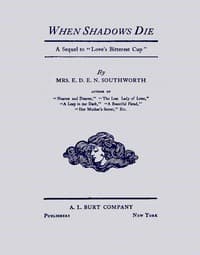
When shadows dieSouthworth, Emma Dorothy Eliza Nevitte
General
When shadows die
Southworth, Emma Dorothy Eliza Nevitte
American fiction -- 19th century
“I would rather be an hour too soon than a second too late, lieutenant,”
replied the young officer, saluting.
“Quite right! Tell the coxswain to wait. He is to take this gentleman
and myself ashore,” said Le.
Then he went down into his cabin, followed by Mr. Force, to make a few
final preparations.
Soon they returned to the deck, went down into the boat, and headed for
the shore.
When they landed, and were walking across the yard, Le asked:
“I may at last marry Odalite without let or hindrance?”
“I have told you so, lad!”
“Yes, bless you, uncle! But how soon? How soon?”
“This very day, if Odalite and her mother agree.”
“Let us walk faster, uncle! Please!” pleaded the impatient lover.
“My dear Le! Consider—consider my rheumatism! Besides, look! There is no
car near the gate, and we shall pass through before one comes up.”
Le saw at once that fast walking would not bring him any sooner to the
side of his sweetheart, and so he moderated his haste.
They reached the gate just as a car came up, and they entered it while
the horses were being unharnessed and turned around.
“If one had but wings!” said Le.
“You would find them inconvenient on most occasions,” replied Mr. Force.
Several other passengers now entered the car, and it started on its
uptown trip.
Passengers from the sidewalks, however, continued to stop the car and
crowd in until it was more than full, for every seat was occupied, and
all the standing room between the rows, as well as both platforms before
and behind.
This was always the condition of the street cars in war times, when
authorities were as careless of the lives of horses as they were of
those of men.
All private conversation was rendered impossible, and Mr. Force rode on
in perfect silence, half suffocated by the close air and heavily pressed
upon by a crowd of men standing up in the middle, hanging on by the
straps and swaying to and fro against the forms of their fellow
passengers.
At last—“long last”—the ordeal was over. The toiling horses reached the
corner of the street on which their hotel was situated, and Mr. Force
pulled the strap to stop the car, and with his companion slowly pushed,
elbowed and worked his way out of the “black hole” in the open air.
“There is one comfort in this difficulty in getting out—though our
clothes are often torn and our flesh scratched or bruised in the
trial—yet it gives the wretched horses a minute’s rest,” said the
squire, as, followed by Le, he made his way across the pavement to the
ladies’ entrance of the house.
Here a great shock met him.
The earl, pale and grave, stood in the hall waiting for him.
He bowed to Le, and then took the arm of his brother-in-law, and said:
“Come with me, Force—lieutenant, you will find the young ladies in the
parlor.”
Le, surprised and vaguely uneasy, hesitated for a moment, and then ran
upstairs.
“What is the meaning of this, Enderby? What has happened?” anxiously
inquired the squire.
“Your wife is not well. She——”
Public-domain text, read in full here on John Shaqi.
Reviews
Reviews
No reviews yet
Be the first to share your thoughts on this work.
Join the Discussion
Join the discussion
Sign in to leave a comment or review.
Sign InorCreate an account