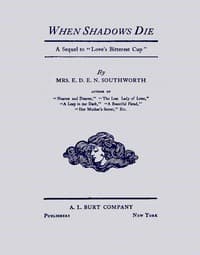
When shadows dieSouthworth, Emma Dorothy Eliza Nevitte
General
When shadows die
Southworth, Emma Dorothy Eliza Nevitte
American fiction -- 19th century
“She is ill! She is dangerously ill! Let me go to her! Let me go to her
at once!” exclaimed the terrified husband, breaking from the earl’s
hold.
“No, no, I beg of you! It would be useless! She is—sleeping! Two
physicians and a nurse watch beside her, and they forbid all approach
for the present. Come in here with me!” said the earl, drawing his
brother-in-law into the nearest room, which happened to be a temporarily
untenanted private parlor.
“When did this happen? Why was I not sent for at once? What is the
nature of her illness? Oh, my dear wife!” exclaimed the squire, as he
fell rather than sat down upon the nearest chair.
The earl closed the door and turned the key, and then answered:
“Not an hour ago! They—Elfrida and her daughter, with Miss Hedge and
myself—were in the drawing room waiting for your arrival before ordering
breakfast. A servant brought in the morning paper, and Wynnette took it
to read aloud for the benefit of the party. She turned first to the
report of the examination of the two prisoners, Silver and Cloud, alias
Stukely and Bayard, and of the demand of the British Government for
their extradition upon charge of piracy and slave dealing.”
“Good Heaven!”
“The demand was said to have come through the British consul at New
York, who had been on the watch for the possible capture by our ships of
this same pirate ship.”
“Then old Grandiere’s word will come true!”
“Probably! But as Wynnette read I happened to look at my sister. She had
grown deadly pale. I arose to go to her, but she raised her hand with a
gesture of command that stopped me, and she listened to the end of the
reading, and then, with her wonderful self-control—deadly pale as she
was—arose to leave the room. Wynnette had not observed the change in her
mother; but Odalite and Elva had done so, and both of them sprang to her
side. Her attack was so sudden and unaccountable.”
“I understand! I understand!” muttered Mr. Force to himself.
“But she waved the girls back in the most peremptory manner, and went
alone to her room. The children came back to me, and gazed in my face
for an explanation. I could give them none. They once more started to
follow their mother. But I called them back, and told them to be
patient. Then the condition of little Rosemary Hedge claimed attention.
She was sobbing violently on the sofa. I told my nieces to respect their
mother’s wish to be left alone; that she was probably overcome by the
ill news of one whom she had known from his boyhood, and that she would
best recover her composure in solitude.”
“I understand! I understand!” again murmured the poor squire to himself.
“I went to Rosemary, and sought to soothe her. While I was so engaged
little Elva slipped away and went up to her mother’s room, and instantly
came shrieking back, telling us, in wild and incoherent exclamations,
that her mother lay unconscious on the floor of her chamber.
“Gracious! Gracious heavens!” groaned the squire.
Public-domain text, read in full here on John Shaqi.
Reviews
Reviews
No reviews yet
Be the first to share your thoughts on this work.
Join the Discussion
Join the discussion
Sign in to leave a comment or review.
Sign InorCreate an account