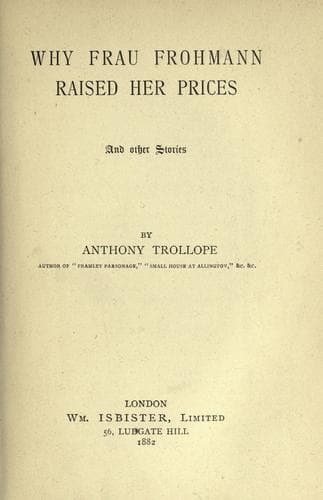
Why Frau Frohmann Raised Her Prices, and Other StoriesTrollope, Anthony
General
Why Frau Frohmann Raised Her Prices, and Other Stories
Trollope, Anthony
English fiction -- 19th century; Manners and customs -- Fiction; Short stories, English
It will have to be told in a following chapter how it was that Fritz
Schlessen had a preponderating influence in the Brunnenthal, arising
from other causes than his professional soundness and general prudence.
It may, however, be as well to explain here that Peter Frohmann the son
sided always with the priest, and attached himself altogether to the
conservative interest. But he, though he was honest, diligent, and
dutiful to his mother, was lumpy, uncouth, and slow both of speech and
action. He understood the cutting of timber and the making of
hay,--something perhaps of the care of horses and of the nourishment of
pigs; but in money matters he was not efficient. Amalia, or Malchen, the
daughter, who was four or five years her brother’s junior, was much
brighter, and she was strong on the reforming side. British money was to
her thinking as good as Austrian, or even Tyrolese. To thrive even
better than her forefathers had thriven seemed to her to be desirable.
She therefore, though by her brightness and feminine ways she was very
dear to the priest, was generally opposed to him in the family
conclaves. It was chiefly in consequence of her persistency that the
table napkins at the Peacock were now changed twice a week.
CHAPTER II.
THE BEGINNING OF TROUBLES.
Of late days, and up to the time of which we are speaking, the chief
contest between the Frau, with the kaplan and Peter on one side, and
Malchen with Fritz Schlessen on the other, was on that most important
question whether the whole rate of charges should not be raised at the
establishment. The prices had been raised, no doubt, within the last
twenty years, or the Frau could not have kept her house open;--but this
had been done indirectly. That the matter may not be complicated for our
readers, we will assume that all charges are made at the Peacock in
zwansigers and kreutzers, and that the zwansiger, containing twenty
kreutzers, is worth eightpence of English money. Now it must be
understood that the guests at the Peacock were entertained at the rate
of six zwansigers, or four shillings, a day, and that this included
everything necessary,--a bed, breakfast, dinner, a cup of coffee after
dinner, supper, as much fresh milk as anybody chose to drink when the
cows were milked, and the use of everything in and about the
establishment. Guests who required wine or beer, of course, were charged
for what they had. Those who were rich enough to be taken about in
carriages paid so much per job,--each separate jaunt having been
inserted in a tariff. No doubt there were other possible and probable
extras; but an ordinary guest might live for his six zwansigers a
day;--and the bulk of them did so live, with the addition of whatever
allowance of beer each might think appropriate. From time to time a
little had been added to the cost of luxuries. Wine had become dearer,
and perhaps the carriages. A bath was an addition to the bill, and
Public-domain text, read in full here on John Shaqi.
Reviews
Reviews
No reviews yet
Be the first to share your thoughts on this work.
Join the Discussion
Join the discussion
Sign in to leave a comment or review.
Sign InorCreate an account