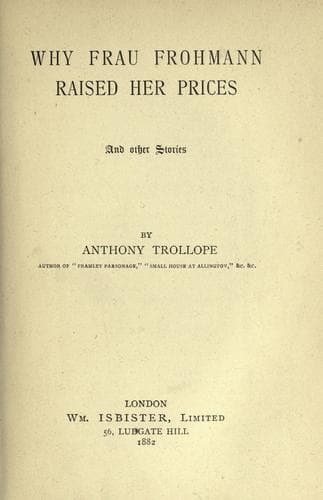
Why Frau Frohmann Raised Her Prices, and Other StoriesTrollope, Anthony
General
Why Frau Frohmann Raised Her Prices, and Other Stories
Trollope, Anthony
English fiction -- 19th century; Manners and customs -- Fiction; Short stories, English
Then she considered the priest’s proposition. Peter, she knew, had shown
himself to be a fool. Though his feelings were good, he always was a
fool. The expenses of the house no doubt might be much diminished in the
manner suggested by Herr Conolin. Salt butter could be given instead of
fresh at breakfast. Cheaper coffee could be procured. The courses at
dinner might be reduced. The second pudding might be discontinued with
economical results. But had not her success in these things been the
pride of her life; and of what good would her life be to her if its
pride were crushed? The Weisses no doubt would come all the same, but
how would they whisper and talk of her among themselves when they found
these parsimonious changes! The Tendel ladies would not complain. It was
not likely that a breath of complaint would ever pass their humble lips;
but she herself, she, Frau Frohmann, who was perhaps somewhat unduly
proud of her character for wealth, would have to explain to them why it
was that that second pudding had been abolished. She would be forced to
declare that she could no longer afford to supply it, a declaration
which to her would have in it something of meanness, something of
degradation. No! she could not abandon the glory of her dinner. It was
as though you should ask a Royal Academician to cease to exhibit his
pictures, or an actor to consent to have his name withdrawn from the
bills. Thus at last she came to that further resolve. The kaplan’s
advice must be rejected, as must that of the lawyer.
But something must be done. For a moment there came upon her a sad idea
that she would leave the whole thing to others, and retire into
obscurity at Schwatz, the village from whence the Frohmanns had
originally come. There would be ample means for private comfort. But
then who would carry on the Peacock, who would look after the farm, and
the timber, and the posting, and the mill? Peter was certainly not
efficient for all that. And Malchen’s ambition lay elsewhere. There
was, too, a cowardice in this idea of running away which was very
displeasing to her.
Public-domain text, read in full here on John Shaqi.
Reviews
Reviews
No reviews yet
Be the first to share your thoughts on this work.
Join the Discussion
Join the discussion
Sign in to leave a comment or review.
Sign InorCreate an account