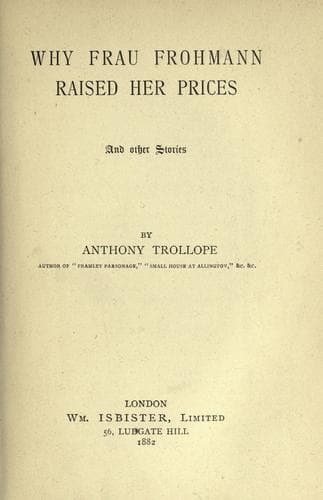
Why Frau Frohmann Raised Her Prices, and Other StoriesTrollope, Anthony
General
Why Frau Frohmann Raised Her Prices, and Other Stories
Trollope, Anthony
English fiction -- 19th century; Manners and customs -- Fiction; Short stories, English
Why need there be any raising of prices at all,--either in one direction
or in the other?--Had she herself never been persuaded into paying more
to others, then she would not have been driven to demand more from
others. And those higher payments on her part had, she thought, not been
obligatory on her. She had been soft and good-natured, and therefore it
was that she was now called upon to be exorbitant. There was something
abominable to her in this general greed of the world for more money. At
the moment she felt almost a hatred for poor Seppel the carpenter, and
regarded that new baby of his as an impertinent intrusion. She would
fall back upon the old wages, the old prices for everything. There would
be a difficulty with that Innsbruck butcher; but unless he would give
way she would try the man at Brixen. In that matter of fowls she would
not yield a kreutzer to the entreaties of her poor neighbours who
brought them to her for sale.
Then she walked forth from the house to a little arbour or summer-house
which was close to the chapel opposite, in which she found Schlessen
smoking his pipe with a cup of coffee before him, and Malchen by his
side. “I have made up my mind. Herr Schlessen,” she said. It was only
when she was very angry with him that she called him Herr Schlessen.
“And what shall I do?” asked the lawyer.
“Do nothing at all; but just destroy that bit of paper.” So saying, the
Frau walked back to the house, and Fritz Schlessen, looking round at
Malchen, did destroy that bit of paper.
CHAPTER III.
THE QUESTION OF THE MITGIFT.
About two months after the events described in the last chapter, Malchen
and Fritz Schlessen were sitting in the same little arbour, and he was
again smoking his pipe, and again drinking his coffee. And they were
again alone. When these two were seated together in the arbour, at this
early period of the season, they were usually left alone, as they were
known to be lovers by the guests who would then be assembled at the
Peacock. When the summer had grown into autumn, and the strangers from a
distance had come, and the place was crowded, then the ordinary
coffee-drinkers and smokers would crowd round the arbour, regardless of
the loves of Amalia and Fritz.
Public-domain text, read in full here on John Shaqi.
Reviews
Reviews
No reviews yet
Be the first to share your thoughts on this work.
Join the Discussion
Join the discussion
Sign in to leave a comment or review.
Sign InorCreate an account