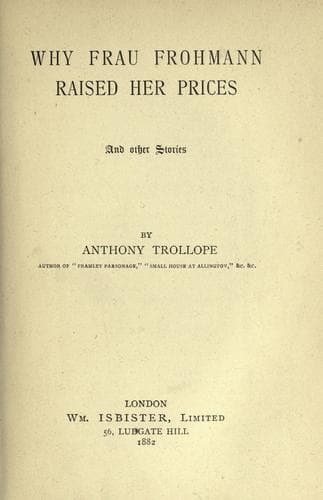
Why Frau Frohmann Raised Her Prices, and Other StoriesTrollope, Anthony
General
Why Frau Frohmann Raised Her Prices, and Other Stories
Trollope, Anthony
English fiction -- 19th century; Manners and customs -- Fiction; Short stories, English
But she would not therefore wish him,--this was his
argument,--she would not on that account require him to work for less
than his due. Seppel put his hand on his heart, and declared that his
honour was concerned. As for his brother’s cart and his huckstery trade
and Karl Muntz, he was simply lending a hand to that till he could get a
settled place as carpenter. He was doing the Frau no harm. If he did not
look after the cart, somebody else would. He was very submissive and
most anxious to avoid her anger; but yet would not admit that he was
doing wrong. But she towered in her wrath, and would listen to no
reason. It was to her all wrong. It was innovation, a spirit of change
coming from the source of all evil, bringing with it unkindness, absence
of charity, ingratitude! It was flat mutiny, and rebellion against their
betters. For some weeks it seemed to the Frau that all the world was
going to pieces.
Her position was the more painful because at the time she was without
counsellors. The kaplan came indeed as usual, and was as attentive and
flattering to her as of yore; but he said nothing to her about her own
affairs unless he was asked; and she did not ask him, knowing that he
would not give her palatable counsel. The kaplan himself was not well
versed in political economy or questions of money generally; but he had
a vague idea that the price of a chicken ought to be higher now than it
was thirty years ago. Then why not also the price of living to the
guests at the Peacock? On that matter he argued with himself that the
higher prices for the chickens had prevailed for some time, and that it
was at any rate impossible to go back. And perhaps the lawyer had been
right in recommending the Frau to rush at once to seven zwansigers and a
half. His mind was vacillating and his ideas misty; but he did agree
with Suse Krapp when she declared that the poor people must live. He
could not, therefore, do the Frau any good by his advice.
As for Schlessen he had not been at the Brunnenthal for a month, and had
told Malchen in Innsbruck that unless he were specially wanted, he would
not go to the Peacock until something had been settled as to the
mitgift. “Of course she is going to lose a lot of money,” said
Schlessen. “Anybody can see that with half an eye. Everybody in the town
is talking about it. But when I tell her so, she is only angry with me.”
Public-domain text, read in full here on John Shaqi.
Reviews
Reviews
No reviews yet
Be the first to share your thoughts on this work.
Join the Discussion
Join the discussion
Sign in to leave a comment or review.
Sign InorCreate an account