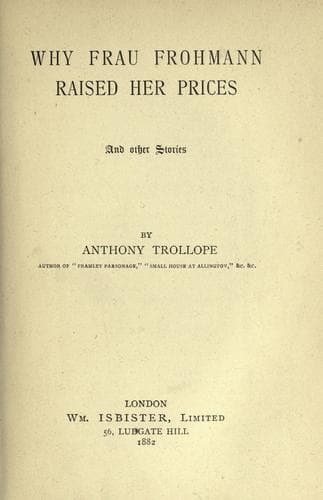
Why Frau Frohmann Raised Her Prices, and Other StoriesTrollope, Anthony
General
Why Frau Frohmann Raised Her Prices, and Other Stories
Trollope, Anthony
English fiction -- 19th century; Manners and customs -- Fiction; Short stories, English
Malchen of course could give no advice. Every step which her mother took
seemed to her to be unwise. Of course the old women would do the best
they could with their eggs. The idea that any one out of gratitude
should sell cheaper to a friend than to an enemy was to her monstrous.
But when she found that her mother was determined to swim against the
stream, to wound herself by kicking against the pricks, to set at
defiance all the common laws of trade, and that in this way money was
to be lost, just at that very epoch of her own life in which it was so
necessary that money should be forthcoming for her own advantage,--then
she became moody, unhappy, and silent. What a pity it was that all this
power should be vested in her mother’s hands.
As for Peter, he had been altogether converted. When he found that a
cart had to be sent twice a week to Brixen, and that the very poultry
which had been carried from the valley to the town had to be brought
back from the town to the valley, then his spirit of conservatism
deserted him. He went so far as to advise his mother to give way. “I
don’t see that you do any good by ruining yourself,” he said.
But she turned at him very fiercely. “I suppose I may do as I like with
my own,” she replied.
Yes; she could do what she liked with her own. But now it was declared
by all those around her, by her neighbours in the valley, and by those
in Innsbruck who knew anything about her, that it was a sad thing and a
bad thing that an old woman should be left with the power of ruining all
those who belonged to her, and that there should be none to restrain
her! And yet for the last twenty-five years previous to this it had been
the general opinion in these parts that nobody had ever managed such a
house as well as the Frau Frohmann. As for being ruined,--Schlessen, who
was really acquainted with her affairs, knew better than that. She might
lose a large sum of money, but there was no fear of ruin. Schlessen was
inclined to think that all this trouble would end in the Frau retiring
to Schwatz, and that the settlement of the mitgift might thus be
accelerated. Perhaps he and the Frau herself were the only two persons
who really knew how well she had thriven. He was not afraid, and, being
naturally patient, was quite willing to let things take their course.
Public-domain text, read in full here on John Shaqi.
Reviews
Reviews
No reviews yet
Be the first to share your thoughts on this work.
Join the Discussion
Join the discussion
Sign in to leave a comment or review.
Sign InorCreate an account