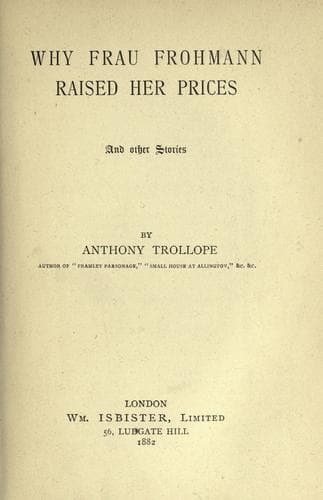
Why Frau Frohmann Raised Her Prices, and Other StoriesTrollope, Anthony
General
Why Frau Frohmann Raised Her Prices, and Other Stories
Trollope, Anthony
English fiction -- 19th century; Manners and customs -- Fiction; Short stories, English
The worst of it to the Frau herself was that she knew so well what
people were saying of her. She had enjoyed for many years all that
delight which comes from success and domination. It had not been merely,
nor even chiefly, the feeling that money was being made. It is not that
which mainly produces the comfortable condition of mind which attends
success. It is the sense of respect which it engenders. The Frau had
held her head high, and felt herself inferior to none, because she had
enjoyed to the full this conviction. Things had gone pleasantly with
her. Nothing is so enfeebling as failure; but she, hitherto, had never
failed. Now a new sensation had fallen upon her, by which at certain
periods she was almost prostrated. The woman was so brave that at her
worst moments she would betake herself to solitude and shed her tears
where no one could see her. Then she would come out and so carry herself
that none should guess how she suffered. To no ears did she utter a word
of complaint, unless her indignation to Seppel, to Suse, and the others
might be called complaining. She asked for no sympathy. Even to the
kaplan she was silent, feeling that the kaplan, too, was against her. It
was natural that he should take part with the poor. She was now for the
first time in her life, driven, alas, to feel that the poor were against
her.
The house was still full, but there had of late been a great falling off
in the midday visitors. It had, indeed, almost come to pass that that
custom had died away. She told herself, with bitter regret, that this
was the natural consequence of her deteriorated dinners. The Brixen meat
was not good. Sometimes she was absolutely without poultry. And in those
matters of puddings, cream, and custards, we know what a falling off
there had been. I doubt, however, whether her old friends had been
stopped by that cause. It may have been so with Herr Trauss, who in
going to Brunnenthal, or elsewhere, cared for little else but what he
might get to eat and drink. But with most of those concerned the feeling
had been that things were generally going wrong in the valley, and that
in existing circumstances the Peacock could not be pleasant. She at any
rate felt herself to be deserted, and this feeling greatly aggravated
her trouble.
“You are having beautiful weather,” Mr. Cartwright said to her one day
when in her full costume she came out among the coffee-drinkers in the
front of the house. Mr. Cartwright spoke German, and was on friendly
terms with the old lady. She was perhaps a little in awe of him as being
a rich man, an Englishman, and one with a white beard and a general
deportment of dignity.
“The weather is well enough, sir,” she said.
“I never saw the place all round look more lovely. I was up at
Sustermann’s saw-mills this morning, and I and my daughter agreed that
it is the most lovely spot we know.”
“The saw-mill is a pretty spot, sir, no doubt.”
Public-domain text, read in full here on John Shaqi.
Reviews
Reviews
No reviews yet
Be the first to share your thoughts on this work.
Join the Discussion
Join the discussion
Sign in to leave a comment or review.
Sign InorCreate an account