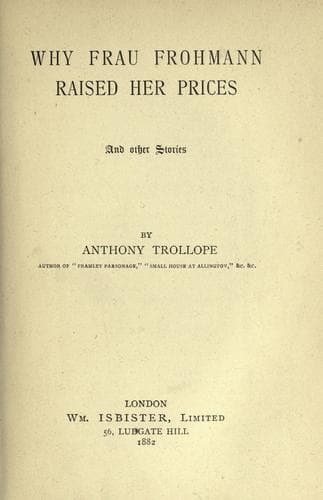
Why Frau Frohmann Raised Her Prices, and Other Stories — John Shaqi
Why Frau Frohmann Raised Her Prices, and Other StoriesTrollope, Anthony
General
Why Frau Frohmann Raised Her Prices, and Other Stories
Trollope, Anthony
English fiction -- 19th century; Manners and customs -- Fiction; Short stories, English
The butcher understood it all, being a tender-hearted man, and
intelligent also. From the first moment of her entrance he knew that
there was something to be said intended only for his own ears. “Come in,
come in, Frau Frohmann,” he said; “we will sit down within, out of the
noise of the street and the smell of the carcases.” With that he led
the way into an inner room, and the Frau followed him. There were
congregated three or four of his children, but he sent them away,
bidding them join their mother in the kitchen. “And now, my friend,” he
said, again taking her hand, “I am glad to see thee. Thirty years of
good fellowship is not to be broken by a word.” By this time the Frau
was endeavouring to hide with her handkerchief the tears which were
running down her face. “I was thinking I would go out to the valley one
of these days, because my heart misgave me that there should be anything
like a quarrel between me and thee. I should have gone, but that, day
after day, there comes always something to be done. And now thou art
come thyself. What, shall the price of a side of beef stand betwixt thee
and me?”
Then she told her tale,--quite otherwise than as she had intended to
tell it. She had meant to be dignified and very short. She had meant to
confess that the Brixen arrangement had broken down, and that she would
resort to the old plan and the old prices. To the saying of this she had
looked forward with an agony of apprehension, fearing that the man would
be unable to abstain from some killing expression of triumph,--fearing
that, perhaps, he might decline her offer. For the butcher was a wealthy
man, who could afford himself the luxury of nursing his enmity. But his
manner with her had been so gracious that she was altogether unable to
be either dignified or reticent. Before half an hour was over she had
poured out to him, with many tears, all her troubles;--how she had
refused to raise her rate of charges, first out of consideration for her
poorer customers, and then because she did not like to demand from one
class more than from another. And she explained how she had endeavoured
to reduce her expenditure, and how she had failed. She told him of
Seppel and Anton, of Suse Krapp and Josephine Bull,--and, above all, of
that traitor at Brixen. With respect to the valley folk Hoff expressed
himself with magnanimity and kindness; but in regard to the rival
tradesman at Brixen his scorn was so great that he could not restrain
himself from expressing wonder that a woman of such experience should
have trusted to so poor a reed for support. In all other respects he
heard her with excellent patience, putting in a little word here and
there to encourage her, running his great steel all the while through
his fingers, as he sat opposite to her on a side of the table.
“Thou must pay them for their ducks and chickens as before,” he said.
“And you?”
Public-domain text, read in full here on John Shaqi.
Reviews
Reviews
No reviews yet
Be the first to share your thoughts on this work.
Join the Discussion
Join the discussion
Sign in to leave a comment or review.
Sign InorCreate an account