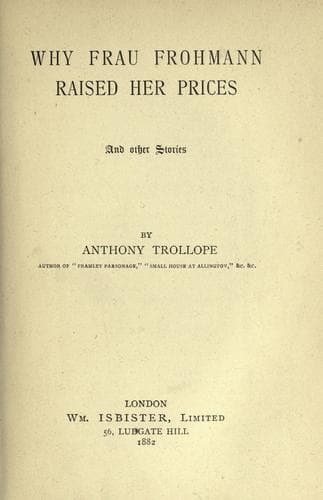
Why Frau Frohmann Raised Her Prices, and Other StoriesTrollope, Anthony
General
Why Frau Frohmann Raised Her Prices, and Other Stories
Trollope, Anthony
English fiction -- 19th century; Manners and customs -- Fiction; Short stories, English
But the Peacock is more than a house. It is almost a village; and yet
every shed, cottage, or barn at or near the place forms a part of the
Frau’s establishment. The centre or main building is a large ordinary
house of three stories,--to the lower of which there is an ascent by
some half-dozen stone steps,--covered with red tiles, and with gable
ends crowded with innumerable windows. The ground-floor is devoted to
kitchens, offices, the Frau’s own uses, and the needs of the servants.
On the first-story are the two living rooms of the guests, the greater
and by far the more important being devoted to eating and drinking.
Here, at certain hours, are collected all the forces of the
establishment,--and especially at one o’clock, when, with many ringing
of bells and great struggles in the culinary department, the dinner is
served. For to the adoption of this hour has the Frau at last been
driven by the increasing infirmities of the world around her. The
scenery of the locality is lovely; the air is considered to be
peculiarly health-compelling; the gossipings during the untrammelled
idleness of the day are very grateful to those whose lives are generally
laborious; the love-makings are frequent, and no doubt sweet; skittles
and bowls and draughts and dominoes have their devotees; and the smoking
of many pipes fills up the vacant hours of the men.
But, at the Brunnenthal, dinner is the great glory of the day. It would
be vain for any æsthetical guest, who might conceive himself to be
superior to the allurements of the table, to make little of the Frau’s
dinner. Such a one had better seek other quarters for his summer’s
holiday. At the Brunnenthal Peacock it is necessary that you should
believe in the paramount importance of dinner. Not to come to it at the
appointed time would create, first marvel, in the Frau’s mind, then
pity,--as to the state of your health,--and at last hot anger should it
be found that such neglect arose from contempt. What muse will assist me
to describe these dinners in a few words? They were commenced of course
by soup,--real soup, not barley broth with a strong prevalence of the
barley. Then would follow the boiled meats, from which the soup was
supposed to have been made,--but such boiled meat, so good, that the
supposition must have contained a falsehood. With this there would be
always potatoes and pickled cabbages and various relishes. Then there
would be two other kinds of meat, generally with accompaniment of stewed
fruit; after that fish,--trout from the neighbouring stream, for the
preservation of which great tanks had been made. Vegetables with unknown
sauces would follow,--and then would come the roast, which consisted
always of poultry, and was accompanied of course by salad. But it was
after this that were made the efforts on which the Frau’s fame most
depended. The puddings, I think, were the subject of her greatest
struggles and most complete success. Two puddings daily were, by the
Public-domain text, read in full here on John Shaqi.
Reviews
Reviews
No reviews yet
Be the first to share your thoughts on this work.
Join the Discussion
Join the discussion
Sign in to leave a comment or review.
Sign InorCreate an account