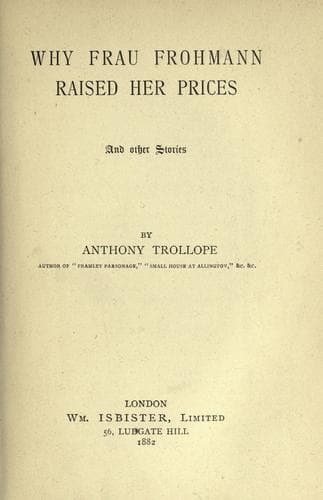
Why Frau Frohmann Raised Her Prices, and Other Stories — John Shaqi
Why Frau Frohmann Raised Her Prices, and Other StoriesTrollope, Anthony
General
Why Frau Frohmann Raised Her Prices, and Other Stories
Trollope, Anthony
English fiction -- 19th century; Manners and customs -- Fiction; Short stories, English
On this floor there is a bedroom or two, and a nest of others above; but
the accommodation is chiefly afforded in other buildings, of which the
one opposite is longer, though not so high, as the central house; and
there is another, a little down the road, near the mill, and another as
far up the stream, where the baths have been built,--an innovation to
which Frau Frohmann did not lend herself without much inward suffering.
And there are huge barns and many stables; for the Frau keeps a posting
establishment, and a diligence passes the door three times each way in
the course of the day and night, and the horses are changed at the
Peacock;--or it was so, at any rate, in the days of which I am speaking,
not very long ago. And there is the blacksmith’s forge, and the great
carpenter’s shed, in which not only are the carts and carriages mended,
but very much of the house furniture is made. And there is the mill, as
has been said before, in which the corn is ground, and three or four
cottages for married men, and a pretty little chapel, built by the Frau
herself, in which mass is performed by her favourite priest once a
month,--for the parish chapel is nearly three miles distant if you walk
by the mountain path, but is fully five if you have yourself carried
round by the coach road. It must, I think, be many years since the Frau
can have walked there, for she is a dame of portly dimensions.
Whether the buildings are in themselves picturesque I will not pretend
to say. I doubt whether there has been an attempt that way in regard to
any one except the chapel. But chance has so grouped them, and nature
has so surrounded them, that you can hardly find anywhere a prettier
spot. Behind the house, so as to leave only space for a little meadow
which is always as green as irrigation can make it, a hill rises, not
high enough to be called a mountain, which is pine-clad from the foot to
the summit. In front and around the ground is broken, but immediately
before the door there is a way up to a lateral valley, down which comes
a nameless stream which, just below the house, makes its way into the
Ivil, the little river which runs from the mountain to the inn, taking
its course through that meadow which lies between the hill and the
house. It is here, a quarter of a mile perhaps up this little stream, at
a spot which is hidden by many turnings from the road, that visitors
come upon the waterfall,--the waterfall which at Innsbruck is so often
made to be the excuse of these outings which are in truth performed in
quest of Frau Frohmann’s dinners. Below the Peacock, where the mill is
placed, the valley is closely confined, as the sombre pine-forests rise
abruptly on each side; and here, or very little lower, is that gloomy or
ghost-like pass through the rocks, which is called the Höllenthor; a
name which I will not translate. But it is a narrow ravine, very dark
in dark weather, and at night as black as pitch. Among the superstitious
Public-domain text, read in full here on John Shaqi.
Reviews
Reviews
No reviews yet
Be the first to share your thoughts on this work.
Join the Discussion
Join the discussion
Sign in to leave a comment or review.
Sign InorCreate an account