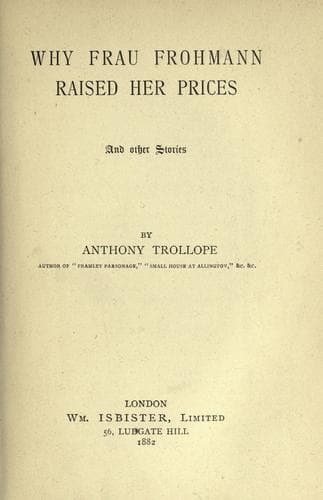
Why Frau Frohmann Raised Her Prices, and Other StoriesTrollope, Anthony
General
Why Frau Frohmann Raised Her Prices, and Other Stories
Trollope, Anthony
English fiction -- 19th century; Manners and customs -- Fiction; Short stories, English
take them quickly to Innsbruck if they were discontented,--have rarely
stuck to their complaints and gone. The comforts of the house, and the
prices charged, and the general charms of the place have generally
prevailed,--so that the complainants, sometimes with spoken apologies,
have in most cases sought permission to remain. In late years the Frau’s
certainty of victory has created a feeling that nothing is to be said
against the arrangements of the Peacock. A displeased guest can exercise
his displeasure best by taking himself away in silence.
The Frau of late years has had two counsellors; for though she is but
ill inclined to admit advice from those who have received no authority
to give it, she is not therefore so self-confident as to feel that she
can live and thrive without listening to the wisdom of others. And those
two counsellors may be regarded as representing--the first or elder her
conscience, and the second and younger her worldly prudence. And in the
matter of her conscience very much more is concerned than simple
honesty. It is not against cheating or extortion that her counsellor is
sharp to her; but rather in regard to those innovations which he and she
think to be prejudicial to the manner and life of Brunnenthal, of
Innsbruck, of the Tyrol, of the Austrian empire generally, and, indeed,
of the world at large. To be as her father had been before her,--for her
father, too, had kept the Peacock; to let life be cheap and simple, but
yet very plentiful as it had been in his days, this was the counsel
given by Father Conolin the old priest, who always spent two nights in
each month at the establishment, and was not unfrequently to be seen
there on other occasions. He had been opposed to many things which had
been effected,--that alteration of the hour of dinner, the erection of
the bathhouse, the changing of plates at each course, and especially
certain, notifications and advertisements by which foreigners may have
been induced to come to the Brunnenthal. The kaplan, or chaplain, as he
was called, was particularly averse to strangers, seeming to think that
the advantages of the place should be reserved, if not altogether for
the Tyrolese, at any rate for the Germans of Southern Germany, and was
probably of opinion that no real good could be obtained by harbouring
Lutherans. But, of late, English also had come, to whom, though he was
personally very courteous, he was much averse in his heart of hearts.
Such had ever been the tendency of his advice, and it had always been
received with willing, nay, with loving ears. But the fate of the kaplan
had been as is the fate of all such counsellors. Let the toryism of the
Tory be ever so strong, it is his destiny to carry out the purposes of
his opponents. So it had been, and was, with the Frau. Though she was
always in spirit antagonistic to the other counsellor, it was the other
counsellor who prevailed with her.
Public-domain text, read in full here on John Shaqi.
Reviews
Reviews
No reviews yet
Be the first to share your thoughts on this work.
Join the Discussion
Join the discussion
Sign in to leave a comment or review.
Sign InorCreate an account