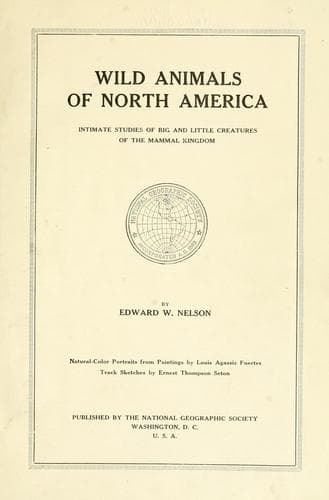
Wild Animals of North America: Intimate Studies of Big and Little Creatures of the Mammal KingdomNelson, Edward William
Science
Wild Animals of North America: Intimate Studies of Big and Little Creatures of the Mammal Kingdom
Nelson, Edward William
Mammals -- North America
The common hares, or gray-sided “jack rabbits” of the Western States,
are among our best known and most interesting mammals. They are
characterized by long, thin necks, long ears tipped with black, long
legs, grayish sides differing but little from the color of the back,
and a rather long tail, black on its upper side and dingy gray below.
They are abundant and generally distributed over a vast and mainly
treeless area in middle North America extending from western Missouri
and eastern Texas to the Pacific coast, and from the border of South
Dakota and the Columbia River Valley of Washington south over the
tableland of Mexico and throughout the peninsula of Lower California.
Within this region they range from sea level up to an altitude of over
9,000 feet. In the North they experience severe winters with much snow,
but never show any winter whitening of their furry coat, as do more
northern hares.
The gray-sided hares over all this extended range belong to a single
species, typified by the California jack rabbit. The area thus occupied
includes many different climatic and other physical conditions, from
the sweeping grassy plains of Kansas to the juniper and pine dotted
plateaus of the Rocky Mountain region, the foggy coast of California,
the hot cactus-grown deserts of the Southwest, and the cool elevations
of the Mexican tableland.
This varying environment has worked on the plastic organization of
the species and modified it into a considerable number of well-marked
geographic races which together make up the gray-sided group of jack
rabbits, in contrast with the white-sided group already described.
Some of the races are very dissimilar in color, but each merges
imperceptibly into its neighboring races, and the group thus forms an
unbroken chain of subspecies.
Like other hares, the jack rabbits are both diurnal and nocturnal
in habits. They do not burrow, but make forms among dense growths
of grass or weeds, or under bushes, where they lie hidden. It is a
question whether they have more than one litter a season, although it
is known that in some parts of their range young are born at all times
throughout the spring and summer. From one to six are produced at a
time, fully clothed in fur and with their eyes open. Within a few days
they leave the “form” and run about like little furry balls. Even at
this early period they are amazingly alert and skillful in evading
capture by quickly doubling and zigzagging when pursued.
[Illustration: A QUADRUPED WITH BIPED TRACK: THE COMMON CAT
The cat does not show its claws in the track. In walking, the hind foot
is set exactly in the track of the front foot; this perfect register
offers many advantages and makes for a silent tread. The track of the
cat will probably be noticed more than that of any other animal, owing
to the large numbers of them in every locality.]
Public-domain text, read in full here on John Shaqi.
Reviews
Reviews
No reviews yet
Be the first to share your thoughts on this work.
Elsewhere in the archive
Join the Discussion
Join the discussion
Sign in to leave a comment or review.
Sign InorCreate an account