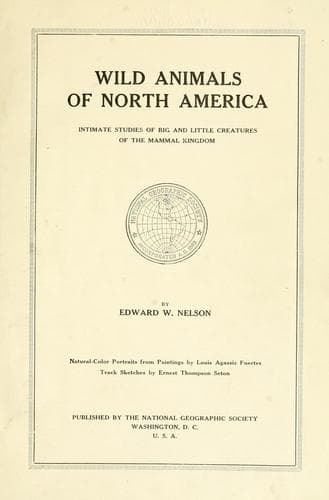
Wild Animals of North America: Intimate Studies of Big and Little Creatures of the Mammal KingdomNelson, Edward William
Science
Wild Animals of North America: Intimate Studies of Big and Little Creatures of the Mammal Kingdom
Nelson, Edward William
Mammals -- North America
During such periods of abundance they invade fields and devastate
grain, forage crops, vineyards, and young orchards. In places they
sometimes actually destroy entire crops and force settlers to abandon
their locations. In winter they swarm about haystacks and destroy many
tons of hay. Depredations of this character were committed by them on a
considerable scale during 1916 in parts of Oregon, Idaho, and Utah.
During the early development of the San Joaquin Valley, California,
jack rabbits became such an intolerable pest that great community
drives were organized. Large woven wire corrals with wing fences
leading away several miles from the entrance were built on the open
plains. The occasions of the drives were made public holidays through
all the surrounding region, and people gathered sometimes to the
number of from 5,000 to 8,000. A great line of beaters was formed,
miles in length, and the jack rabbits were driven between wing fences
into corrals. Four such drives in Fresno County in the spring of 1892
resulted in the destruction of 40,000 jack rabbits, one drive netting
more than 20,000 animals.
At this time the level floor of the San Joaquin Valley was crossed by
numberless well-worn rabbit trails six or eight inches broad and one or
two inches deep, extending in long straight lines sometimes for miles.
On approaching a patch of large weeds one often saw twenty or thirty
jack rabbits dash out and, after hopping away a short distance, sit
with upstanding ears to look curiously at the intruder.
It is a general rule that when any species of animal becomes extremely
numerous it loses its ordinary wariness and, conversely, when its
numbers are materially reduced its wariness is greatly increased. The
periods of abundance of jack rabbits usually extend through several
years until, at the height of their increase, a contagious malady
suddenly sweeps them away almost to the point of extinction, as in the
case of the varying hare. A period of years follows during which their
numbers are slowly recovered.
Jack rabbits are specially adapted for life on great plains, where
speed and the ability to subsist on almost any form of vegetation are
prime qualities. They are as grotesquely characteristic of the Western
States as the kangaroos were of Australia, and have entered largely
into the literature of the region they occupy.
=THE VARYING HARES= (=Lepus americanus= and its relatives)
(_For illustration, see page 507_)
The varying hares, white rabbits, or snowshoe rabbits, as they are
known, form a small group of closely related species and geographic
races of hares peculiar to northern North America. They sometimes
attain a weight of five pounds and are about half the size of the
arctic hares, which they resemble in form, except that they are more
heavily built and have proportionately shorter legs and larger hind
feet.
Public-domain text, read in full here on John Shaqi.
Reviews
Reviews
No reviews yet
Be the first to share your thoughts on this work.
Elsewhere in the archive
Join the Discussion
Join the discussion
Sign in to leave a comment or review.
Sign InorCreate an account