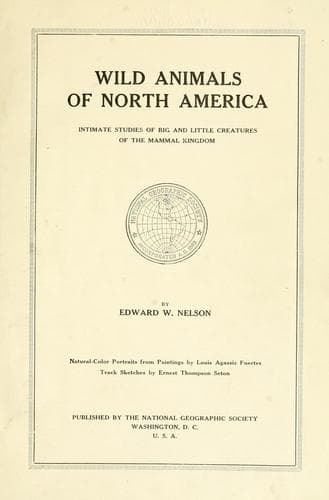
Wild Animals of North America: Intimate Studies of Big and Little Creatures of the Mammal KingdomNelson, Edward William
Science
Wild Animals of North America: Intimate Studies of Big and Little Creatures of the Mammal Kingdom
Nelson, Edward William
Mammals -- North America
With a single exception they become white in winter and change to dusky
or brownish in summer. The molt from the brown summer coat to the
white winter one occurs with the arrival of winter snows, the exact
time varying according to the season, the reverse change in spring
being governed in a similar way by the disappearance of the snow. In
the southern part of their range the change to the white winter coat
is less complete than in the North. There has been much controversy
over the manner of this change in color, some maintaining that on the
approach of winter the hairs turn white with the first snow. It has
been definitely proved, however, that both seasonal changes are due to
molt.
The Washington hare (_Lepus washingtoni_), which remains brown
throughout the year, is the exception to the rule of white winter coats
in this group of hares. It lives in the cool, dense forests of the
humid coast belt of Washington and adjacent part of British Columbia,
where the snowfall does not affect its pelage.
In winter the large hind feet of the varying hares and their long,
spreading toes are entirely covered with a heavy coat of hair, forming
broad snowshoe-like pads, which enable their possessors to move about
freely over the soft snow, a peculiarity that has given rise to one of
the names in common use.
In cool, forested regions varying hares range from Maine and extreme
eastern Canada, including Newfoundland, to the Pacific coast, and from
the stunted bushes bordering the northern limit of trees south to the
northern border of the United States and beyond, following the higher
Alleghenies to West Virginia, the Rocky Mountains to New Mexico, and
well down the Sierra Nevada in California.
As in the case of other species, these hares make “forms” in which
they lie by day, for they are mainly nocturnal in habits. The mating
season occurs in early spring, when the males become very restless,
several sometimes congregating in the same vicinity and occasionally
fighting and chasing one another about. At this time, as well as at
other seasons, snowshoe rabbits have a habit of thumping rapidly on the
ground, making a dull sound audible for some distance. This is probably
done with the hind feet, as is known to be the case with the European
rabbit.
The thumping is apparently a signal and may be a part of the mating
display, but is also used for warning purposes. Hunters in northern
Canada call these rabbits by making a harsh squeaking noise with their
lips. Sometimes they become so eager and excited on hearing this call
that with odd little grunting sounds they come bounding close up to the
hunter.
Public-domain text, read in full here on John Shaqi.
Reviews
Reviews
No reviews yet
Be the first to share your thoughts on this work.
Elsewhere in the archive
Join the Discussion
Join the discussion
Sign in to leave a comment or review.
Sign InorCreate an account