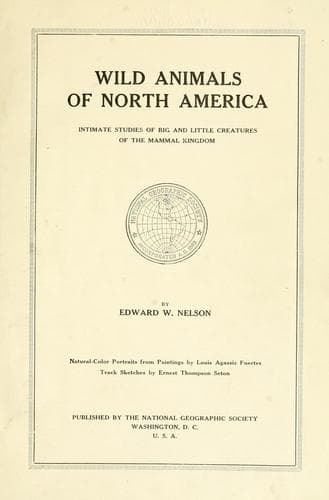
Wild Animals of North America: Intimate Studies of Big and Little Creatures of the Mammal KingdomNelson, Edward William
Science
Wild Animals of North America: Intimate Studies of Big and Little Creatures of the Mammal Kingdom
Nelson, Edward William
Mammals -- North America
The young, varying from two to seven, are born in nests made of dry
leaves, grasses, and other suitable vegetation, warmly lined with hair
from the mother’s body, and usually hidden under brush or in dense
vegetation. The young, which have their eyes open and are fully furred
at birth, within a few days leave the nest and move freely about.
Although the mother snowshoe rabbit will defend her young at first even
at the risk of her life, when they are half grown she leaves them to
shift for themselves. Young hares of various ages when caught often
utter shrill squealing cries of fright and the older animals when
wounded and caught sometimes do the same.
Perhaps through living so constantly in low ground, among swamps and
along streams, varying hares become less averse to entering water
than most of their kind. In the delta of the Yukon River I saw many
places where they had crossed small streams in spring, their wet tracks
entering and leaving the water, thus furnishing unmistakable evidence.
Curiously enough, when caught by a flood they will take refuge on
stumps or other support and often remain to starve rather than swim
ashore.
In summer, owing to their nocturnal habits and the dense thickets
they inhabit, varying hares are rarely seen unless they are unusually
plentiful. In winter their presence is known by their conspicuous
tracks, leading in every direction through their haunts. A single
animal will in one night so thoroughly track the snow in a patch of
woods it gives the impression that several must have been there.
In river bottoms, among densely wooded swamps, these rabbits frequently
make definite beaten runways in the snow; runways are also made through
thickets in their summer haunts. This habit renders it easy to snare
them, and enormous numbers are thus captured every winter.
They feed on a variety of small herbage in summer and in winter
depend on buds, twigs, and the bark of shrubs and small trees. They
are specially fond of willows, and their winter distribution in many
districts is governed by the abundance of willow thickets.
Varying hares are one of the most important mammals of the northern fur
country. They are generally distributed and exist in such numbers that
they are an important source of food supply both to the Indians and to
such predatory birds and mammals as the great horned and snowy owls,
the goshawk, gyrfalcon, lynx, fox, ermine, fisher, and others. The
skins are also used by the Indians for robes.
[Illustration: FOOTPRINTS OF THE VARYING HARE, OR SNOWSHOE RABBIT
The great size of the feet from which the creature is named is a strong
feature of the track, distinguishing it from that of the cottontail and
others (see pages 489 and 507).]
Public-domain text, read in full here on John Shaqi.
Reviews
Reviews
No reviews yet
Be the first to share your thoughts on this work.
Elsewhere in the archive
Join the Discussion
Join the discussion
Sign in to leave a comment or review.
Sign InorCreate an account