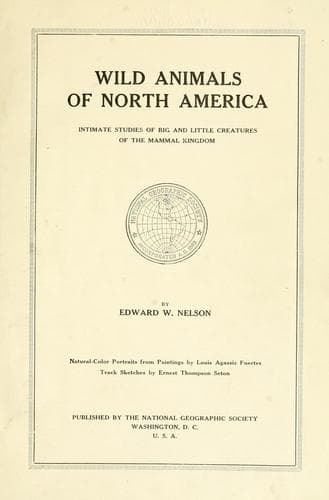
Wild Animals of North America: Intimate Studies of Big and Little Creatures of the Mammal KingdomNelson, Edward William
Science
Wild Animals of North America: Intimate Studies of Big and Little Creatures of the Mammal Kingdom
Nelson, Edward William
Mammals -- North America
The distribution of the marsh rabbit is limited to the southeastern
coastal States from Dismal Swamp, Virginia, to Mobile Bay, Alabama. It
is common in suitable places in Florida. Its larger relative, the swamp
rabbit, ranges west from this area to Texas and up the Mississippi
Valley to Illinois and southeastern Kansas. Swamp rabbits are numerous
in the low, wooded coastal region of Louisiana. They are larger and
longer-legged than marsh rabbits and fleeter of foot.
Among all the rabbits of the world the marsh and swamp rabbits are the
only species which have aquatic habits. Both live mainly in marshes,
wooded swamps, and along the low wooded courses of streams. Other
rabbits and hares are occasionally known to cross water by swimming,
but the marsh and swamp rabbits live about the water and take to it
with all the freedom of a muskrat or mink. The marsh rabbit appears to
be the more aquatic of the two, as the swamp rabbit sometimes lives in
the forest, farther back from the water.
The Tropical wood rabbits are habitants of the dense forests, where
they are well hidden under the rank undergrowth. They are not known
to enter the water, but, like their northern relatives, make runways
through the dense vegetation they frequent. The marsh rabbits live
in cypress or other fresh-water swamps, heavily wooded bottoms, and
fresh water, as well as brackish marshes. They feed on a variety of
vegetation growing in such places and dig up such edible roots as the
wild potato and amaryllis.
Both marsh and swamp rabbits have several litters of from two to six
young each season, beginning in April. The young are born in large,
well-made covered nests, which are built of rushes, grasses, and leaves
and lined with hair from the parents. The nests, which have an entrance
on one side, are usually located in the midst of dense growths of
vegetation or on tussocks, in low, swampy places, and are sometimes
surrounded by water. In the most frequented parts of marsh and swamp
these rabbits make well-trodden trails through the dense vegetation.
When alarmed, marsh rabbits run for the nearest water, into which they
plunge and swim quickly to the shelter of aquatic plants or other
cover. When cut off from escape by water they try to avoid capture by
doubling and turning, but are so short-legged that they are readily
overtaken by a dog. The tracks of these rabbits in the mud differ from
those of the cottontails in showing imprints of the spreading toes.
Public-domain text, read in full here on John Shaqi.
Reviews
Reviews
No reviews yet
Be the first to share your thoughts on this work.
Elsewhere in the archive
Join the Discussion
Join the discussion
Sign in to leave a comment or review.
Sign InorCreate an account