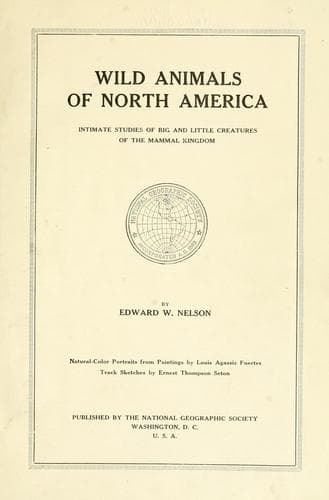
Wild Animals of North America: Intimate Studies of Big and Little Creatures of the Mammal KingdomNelson, Edward William
Science
Wild Animals of North America: Intimate Studies of Big and Little Creatures of the Mammal Kingdom
Nelson, Edward William
Mammals -- North America
In South Carolina Bachman once found numerous marsh rabbits in the
thickets about recently flooded rice fields and swamps. When he beat
the bushes the rabbits plunged into the water and swam away so rapidly
that some escaped from a Newfoundland dog which accompanied him.
Several, apparently thinking themselves unnoticed, stopped and remained
motionless about fifteen yards from the shore, with only their eyes and
noses showing above water. Thus concealed in the muddy water, with ears
laid flat on their necks, they were difficult to see. When touched with
a stick they appeared unwilling to move until they saw that they were
discovered, when they quickly swam away.
Later, when the water subsided to its regular channels, where it was
about eight feet deep, many of the rabbits were seen swimming about,
meeting and pursuing one another as if in sport. One which Bachman had
in captivity during warm weather would lie for hours in a trough partly
filled with water, with which the cage was furnished.
=THE PIKA, OR CONY= (=Ochotona princeps= and its relatives)
(_For illustration, see page 511_)
The pika, little chief hare, or cony, as it is variously named, is
among the most attractive and interesting of our mountain animals. It
is about the size and shape of a small guinea-pig, with a short, blunt
head, broad, rounded ears, short legs, practically no tail, and a long,
fluffy coat of fur. While most nearly related to the hares and rabbits,
it has very different habits.
The pikas form a group comprising many species, much alike in general
appearance and distributed among the high mountains, from the Urals
of Russia through Asia and northern North America. In Asia they occur
mainly in the mountains through the middle of the continent south
to the Himalayas. In Pleistocene time they ranged across Europe to
England. In North America they are limited to the western side of the
continent, from the Mount McKinley region of Alaska down the Rocky
Mountains to New Mexico and along the Cascades and Sierra Nevada to the
Mount Whitney region, in California.
Giving to these North American animals the appellation “cony” is one of
many instances in which the name of an Old World animal is brought to
America to designate a totally unrelated species. Once fixed in current
use, the misapplied term is certain to persist.
Pikas are among the few mammals which live permanently along the high
crests of the mountains, mainly above timberline, but they also descend
in rock slides among the upper spruces, firs, and pines. The altitude
of their haunts varies with the latitude, being between 8,000 and
13,500 feet in the United States, but in Alaska much lower.
Public-domain text, read in full here on John Shaqi.
Reviews
Reviews
No reviews yet
Be the first to share your thoughts on this work.
Elsewhere in the archive
Join the Discussion
Join the discussion
Sign in to leave a comment or review.
Sign InorCreate an account