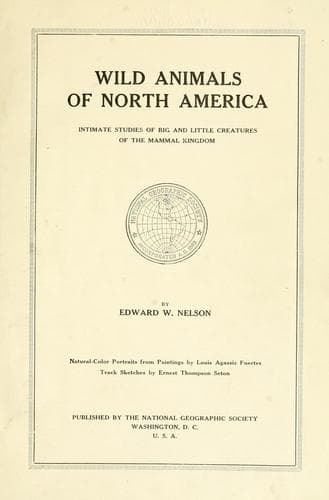
Wild Animals of North America: Intimate Studies of Big and Little Creatures of the Mammal KingdomNelson, Edward William
Science
Wild Animals of North America: Intimate Studies of Big and Little Creatures of the Mammal Kingdom
Nelson, Edward William
Mammals -- North America
In these cool, alpine regions the little animals live wholly within the
shelter of rock slides and among the crevices of shattered rock masses.
Their distribution is unaccountably broken, and although abundant in
many places, they are absent from many others equally suitable. Their
homes are in the midst of the flower-bedecked glacial valleys and
basins, the haunts of the big marmots and mountain sheep.
They are mainly diurnal in habits, and throughout the day may be heard
their odd little barking, or bleating note, like the syllables “eh-eh”
repeated at intervals in a nasal tone, resembling the sound made by
squeezing a toy dog. Occasionally they may be heard barking at night,
perhaps when disturbed by some prowling enemy. Their notes have a
curiously ventriloquial quality, which renders it difficult to locate
the animals uttering them.
Owing to their dull gray or brownish colors, the pikas blend with their
background so completely that when quietly sitting on a rock they
are extremely difficult to see. Even when running about at a little
distance they are not easily noted. Their movements are quick and they
scamper over the rough surface of a rock slide with surprising agility.
Little is known of their more intimate life history. Their young, three
or four in number, are born usually during the first half of summer and
are out foraging when less than half-grown.
Small, bright eyes and big, rounded ears give pikas an odd and
attractive appearance, unlike that of any other mountain animal. They
are extremely watchful and at the first alarm disappear in the shelter
of their rocky fortresses. Their little bark, however, continues to
come up from their hiding places with constant iteration. If the
observer will sit quietly at some good vantage point his patience will
eventually be rewarded by the appearance of the pika on the top of a
stone near the mouth of its retreat.
After a time, if everything is quiet, it resumes its scampering about
over the rocks or may come to the border of the slide and make little
excursions across the open ground after some of its forage plants.
Skipping nimbly from the border of the slides to neighboring patches of
vegetation, sometimes fifty or more feet away, the pika nips off the
stems of short grasses or other plants and taking them up, like small
bundles, crosswise in its mouth, runs back to add them to its “stacks.”
These sallies are quick little runs, made as though in fear of being
long away from the safety of the rocks. Caution is needful, however,
in a world where lurk such enemies as coyotes, lynxes, foxes, weasels,
hawks, and owls.
Public-domain text, read in full here on John Shaqi.
Reviews
Reviews
No reviews yet
Be the first to share your thoughts on this work.
Elsewhere in the archive
Join the Discussion
Join the discussion
Sign in to leave a comment or review.
Sign InorCreate an account