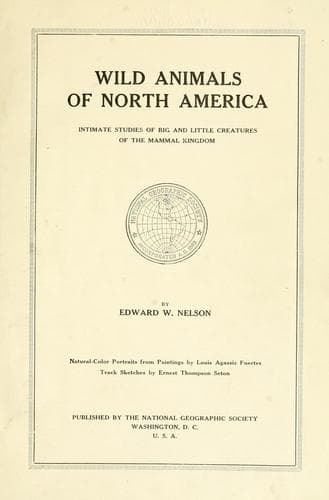
Wild Animals of North America: Intimate Studies of Big and Little Creatures of the Mammal KingdomNelson, Edward William
Science
Wild Animals of North America: Intimate Studies of Big and Little Creatures of the Mammal Kingdom
Nelson, Edward William
Mammals -- North America
During late summer the pikas have the extraordinary habit of gathering
stores of small herbage in piles containing sometimes a bushel each,
usually well sheltered in dry places under the rocks where they live.
Pikas are active all winter, and these little stacks of well-cured hay,
containing a great variety of small plants, serve them as food during
the severe cold season, when at these high altitudes they are buried
under many feet of snow.
In pleasant weather, near the end of summer, visitors to the mountains
of Colorado, Glacier National Park, the high slopes of Mount Shasta, or
of the Sierra Nevada may have the pleasure of watching the pikas hard
at work doing their “haying.” One of their “stacks” in the mountains
of New Mexico contained thirty-four kinds of plants, including many
flowers. No one who once becomes acquainted with these unique and
gentle little animals will ever cease to remember them with friendly
interest.
[Illustration: THE TRAIL OF A FIELD OR MEADOW MOUSE
When compared with that of the deermouse, one notes the absence of the
tail mark and the rarity of the fore feet being paired (see pages 505
and 522).]
=THE PORCUPINE= (=Erethizon dorsatum= and its relatives)
(_For illustration, see page 514_)
The porcupine is one of the most grotesque of the smaller North
American mammals. With a weight of from fifteen to twenty pounds, its
heavy body is supported on short legs, the feet resting flat on the
ground like those of the raccoon, instead of on the toes, as in most
small animals.
Its strongest peculiarity is the specialized development of most of
the fur into rigid, sharp-pointed spines or “quills” from half an inch
to over three inches in length. That the spines represent the underfur
of ordinary mammals is evident from the fact that they are overlaid by
long, coarse guard hairs, sometimes several times their length.
The spiny armament usually lies flat on the body, but when the animal
is excited or alarmed it may be raised, by special muscles on the
underside of the skin, into a bristling array of barbed points. The
spines are so slightly attached that when their points enter the skin
of an enemy they at once become free at the base. The points firmly
set in the skin of another animal, the spines can be withdrawn only
with considerable effort, and if left will gradually work deeper and
may traverse a considerable part of the victim’s body before finally
becoming encysted.
Public-domain text, read in full here on John Shaqi.
Reviews
Reviews
No reviews yet
Be the first to share your thoughts on this work.
Elsewhere in the archive
Join the Discussion
Join the discussion
Sign in to leave a comment or review.
Sign InorCreate an account