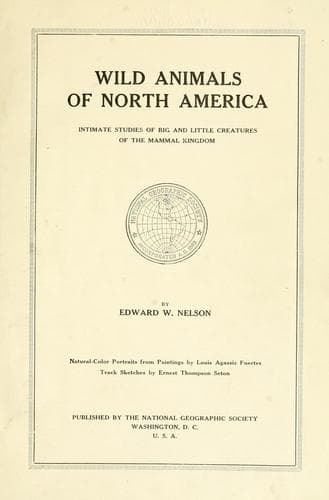
Wild Animals of North America: Intimate Studies of Big and Little Creatures of the Mammal KingdomNelson, Edward William
Science
Wild Animals of North America: Intimate Studies of Big and Little Creatures of the Mammal Kingdom
Nelson, Edward William
Mammals -- North America
When assailed the porcupine turns down its head, arches its back,
and, on firmly planted feet with all its spines erected into a
bristling cover, awaits the enemy. The instant its body is touched the
club-shaped tail, armed with a multitude of spines, is swung vigorously
around and the animal so incautious as to receive the blow is pierced
by a host of stinging darts which, freed from the porcupine, remain
to torment the aggressor. This swift and effective sweep of the tail
has probably given rise to the idea that the porcupine can “shoot” its
quills when defending itself.
Despite its defensive powers, however, the porcupine is, on occasion,
successfully attacked by various enemies, including the mountain lion,
bobcat, fisher, and even the eagle and great horned owl. The fisher is
said habitually to kill and feed upon them, and the encysted quills are
commonly found under its skin.
The frightful effect of an ill-judged attack on a porcupine is shown
by inexperienced dogs after their first encounter with this strange
beast. That such an attack is a dangerous venture, even by the
craftiest and most powerful of its enemies, is well demonstrated by
occasional fatalities among large carnivores which result from the
great mass of spines imbedded in their heads and bodies.
The North American porcupine is a northern animal belonging mainly
to coniferous forests, and ranges from sea level to timberline. It
originally occupied nearly all the forested parts of the continent
south to West Virginia, southern Illinois, the Davis Mountains of
western Texas, and the southern end of the Sierra Nevada in California,
but was absent from the Southeastern States and the lower Mississippi
Valley.
While characteristically a woodland animal, at times it wanders from
forest shelters and has been found prowling about above timberline on
high mountains, and among alder thickets beyond the limit of trees in
the far North. They are usually silent, but at times utter a curious
squealing cry, and in addition have a variety of snuffing, growling,
and chattering noises.
In the forests of tropical America, from Mexico to Brazil, other and
shorter-quilled porcupines occur, characterized by smaller size and
slenderer bodies with a long tail, the terminal half of which is naked
and prehensile like that of an opossum. These animals inhabit forests
where no conifers grow, and are much more arboreal in habits than their
northern relatives. Still other and even more strikingly different
porcupines occur in Europe, Asia, and Africa, some of the African
animals having heavy spines more than twelve inches long.
All porcupines are true rodents, and the name hedgehog is erroneously
used when applied to any of them. Hedgehogs are small Old World
insect-eating mammals, which have their backs covered with
porcupine-like spines, but are in no way related to the porcupines.
Public-domain text, read in full here on John Shaqi.
Reviews
Reviews
No reviews yet
Be the first to share your thoughts on this work.
Elsewhere in the archive
Join the Discussion
Join the discussion
Sign in to leave a comment or review.
Sign InorCreate an account