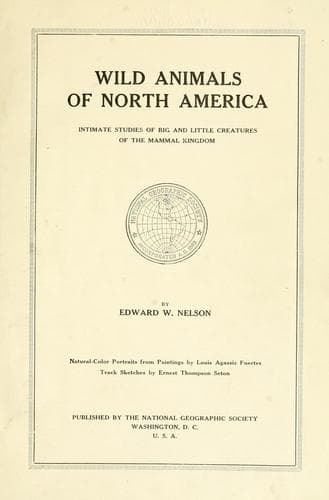
Wild Animals of North America: Intimate Studies of Big and Little Creatures of the Mammal KingdomNelson, Edward William
Science
Wild Animals of North America: Intimate Studies of Big and Little Creatures of the Mammal Kingdom
Nelson, Edward William
Mammals -- North America
Although they have no near relatives in the Old World, some of the
African and Asiatic jerboas are externally almost perfect replicas of
the kangaroo rats in every detail of form, color, and color pattern,
even to the tail markings. This extraordinary likeness in appearance of
two widely separated and unrelated animals is made doubly significant
by the fact that both live in deserts and have similar habits.
Peculiarly desert animals, kangaroo rats live like the pocket mice,
without drinking, but obtain the necessary water through their
digestive processes. They are most numerous in sandy areas, and there
the earth is sometimes so riddled by their burrows as to render
horseback riding difficult.
Kangaroo rats are nocturnal and always live in burrows dug by
themselves. As a rule they prefer soft or sandy ground, but some
species occupy areas where the earth is hard and rocky. The burrows
of some species have only one or two entrances with a small amount of
earth thrown out, but others make little mounds with several openings,
entering usually nearly on a level or at a slight incline. These
openings are nearly always conspicuous, and while frequently near
bushes, no effort appears ever to be made to conceal them, and a little
trail often leads away through the soft earth.
The large _Dipodomys spectabilis_, which lives mainly in New Mexico
and Arizona, constructs the most notable of all the dwelling places of
these animals. From its underground workings it throws up large mounds
of earth, which gradually increase in size with the length of time
they are occupied until they are sometimes more than 3 feet high and
15 feet or more in diameter. From three to a dozen burrows enter these
mounds, usually at the surface level of the ground, but some are on the
slopes of the mound. The mounds, usually located in open ground, with
their round entrance holes from four to five inches in diameter, are
extremely conspicuous.
Although generally scattered at varying distances from one another, the
mounds are sometimes grouped in colonies. Well-worn trails three or
four inches broad lead away from the entrances, some to other mounds
showing neighborly intercourse and others far away to the feeding
grounds, sometimes 200 or 300 yards distant. One of the openings at
the side of the mound is usually the main entrance, and by day this is
ordinarily kept stopped with fresh earth. Within the mound and farther
under ground are dug a series of ramifying passages, among which are
located roomy nest chambers and store-rooms for food.
Public-domain text, read in full here on John Shaqi.
Reviews
Reviews
No reviews yet
Be the first to share your thoughts on this work.
Elsewhere in the archive
Join the Discussion
Join the discussion
Sign in to leave a comment or review.
Sign InorCreate an account