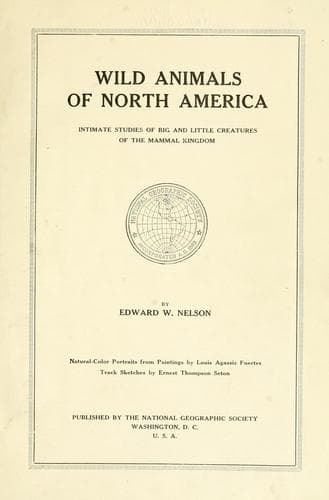
Wild Animals of North America: Intimate Studies of Big and Little Creatures of the Mammal KingdomNelson, Edward William
Science
Wild Animals of North America: Intimate Studies of Big and Little Creatures of the Mammal Kingdom
Nelson, Edward William
Mammals -- North America
Kangaroo rats are not known to hibernate in any part of their range.
They lay up food for temporary purposes at least and do not go abroad
in stormy or cold weather. The northern species and those on the
colder mountain slopes must make large store against the winter needs.
Their food consists mainly of seeds, leaves of several plants, and of
little plants just appearing above ground. Tiny cactus plants and the
saline fleshy leaves of _Sarcobatus_ are often among the kinds gathered
for food.
The big _Dipodomys spectabilis_ appears to be more social than most of
its kind, as several may be caught in a single mound, and, as already
said, well-worn trails lead from mound to mound. A little noise made
just outside one of these mounds usually brings a reply or challenge
in the form of a low drumming or thudding noise, no doubt made by the
animal rapidly striking the ground with its hind feet like a rabbit or
wood rat.
When caught they at first struggle to escape, but, like a rabbit, do
not offer to bite, and soon become quiet. They have from two to six
young, which may be born at any season. Nothing appears to be known
concerning the number of litters in a year.
When in camp at San Ignacio, in the middle of the desert peninsula
of Lower California, I had an unusual opportunity to learn something
of the habits of one of the smaller species of kangaroo rat abundant
there. The moon was at its full, and in the clear desert air its
radiance rendered objects near at hand almost as distinct as by day.
Scattered grains of rice and fragments of food on the ground about the
cook tent attracted many kangaroo rats and pocket mice.
During several nights I passed hours watching at close range the habits
of these curious animals. As I sat quietly on a mess box in their
midst both the kangaroo rats and the mice would forage all about with
swift gliding movements, repeatedly running across my bare feet. Any
sudden movement startled them and all would dart away for a moment, but
quickly return.
Although the kangaroo rats did not become so fearless and friendly as
the pocket mice, they were so intent on the food that at times I had
no difficulty in reaching slowly down and closing my hand over their
backs. I did this dozens of times, and after a slight struggle they
always became quiet until again placed on the ground, when they at once
renewed their search for food as though no interruption had occurred.
One night, to observe them better, I spilled a small heap of rice on
the sand between my feet. Within two or three minutes half a dozen
kangaroo rats had discovered it and were busily at work filling their
cheek pouches with the grains and carrying them away to their store
chambers.
Public-domain text, read in full here on John Shaqi.
Reviews
Reviews
No reviews yet
Be the first to share your thoughts on this work.
Elsewhere in the archive
Join the Discussion
Join the discussion
Sign in to leave a comment or review.
Sign InorCreate an account