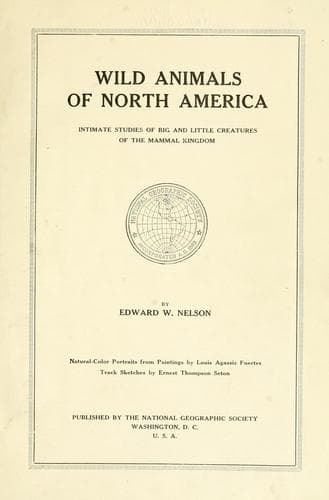
Wild Animals of North America: Intimate Studies of Big and Little Creatures of the Mammal KingdomNelson, Edward William
Science
Wild Animals of North America: Intimate Studies of Big and Little Creatures of the Mammal Kingdom
Nelson, Edward William
Mammals -- North America
Muskrats are peculiar to North America, where they exist in great
numbers. Aquatic in habits, they have a wide distribution along streams
of all sizes and among marshes, ponds, and lakes from the Atlantic to
the Pacific, and from a little beyond the limit of trees on the Arctic
barrens south throughout most of the United States. They reach our
southern border at the delta of the Mississippi and the delta of the
Colorado, at the head of the Gulf of California.
Within this vast area they have been modified by their environment into
several species and geographic races, none of which differ much in
appearance from the well-known animal of the Eastern States.
The nearest kin of the muskrats are the short-tailed field mice, so
numerous in our damp meadows. Like the latter, the muskrat has several
litters of young each season. The young are born blind, naked, and
helpless, and number from three to thirteen to a litter. This great
fecundity has enabled the muskrats to hold their own through years of
persistent trapping.
They still occupy practically all their original range and yield a
steady toll of valuable fur each season. In 1914 more than 10,000,000
of their skins were sold in London, and other millions were handled
in America. The aggregate returns on muskrat skins are so great as to
constitute it our most valuable fur-bearer. The furriers make its skins
up in its natural color or dress and dye it and give it the trade names
of “Hudson seal,” “river mink,” or “ondatra mink.”
In suitable marshes, as on the eastern shore of Maryland, muskrats
become extremely abundant and render such areas valuable as natural
“fur farms.” One Maryland marsh containing 1,300 acres has yielded
from $2,000 to $7,000 worth of skins a year. Not only are the skins of
value, but the flesh is palatable, and is sold readily under the trade
name of “marsh rabbit” in the markets of Baltimore, Philadelphia, and
elsewhere.
There is little doubt that owners of favorably situated marshes could
derive from them a steady revenue by keeping them stocked with proper
food plants and protecting the muskrats from their enemies. The value
of these fur-bearers is becoming more and more appreciated and many
States have laws restricting the trapping season to a period in fall
and winter when the fur is prime.
In marshes about shallow lakes or bordering sluggish rivers muskrats
build roughly conical lodges or “houses,” three to four feet high, with
bases, usually in shallow water, several feet broader. These houses
are made of roots and stems of plants with a mixture of mud. An oval
chamber is left in the interior, well above the water level, to which
entrance is gained by one or more passageways opening under water.
These shelters are mainly for winter use, but the young are sometimes
born in them as well as in large grass nests among dense marsh
vegetation.
Public-domain text, read in full here on John Shaqi.
Reviews
Reviews
No reviews yet
Be the first to share your thoughts on this work.
Elsewhere in the archive
Join the Discussion
Join the discussion
Sign in to leave a comment or review.
Sign InorCreate an account