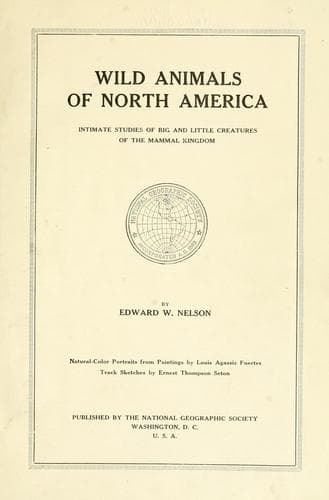
Wild Animals of North America: Intimate Studies of Big and Little Creatures of the Mammal KingdomNelson, Edward William
Science
Wild Animals of North America: Intimate Studies of Big and Little Creatures of the Mammal Kingdom
Nelson, Edward William
Mammals -- North America
The curious conical lodges are familiar objects about marshes in the
Eastern and Northern States, and I remember seeing, a few years ago, a
specially well-formed muskrat house close to the historic bridge, at
Concord, and others along the Concord River. Within ten years muskrat
houses were common in marshy ponds in Potomac Park, Washington, where
the Lincoln Memorial Building now stands.
Where the banks of streams or lakes rise abruptly, the muskrats make
their home in dry chambers in the banks above water level at the end of
a tunnel opening either under water or close to the water level. Worn
trails lead up the banks about such places and well-marked runways are
made through the heavy reeds and marsh grasses in their haunts.
Muskrats are mainly nocturnal animals, but often move about during the
day. I have seen them repeatedly swimming close to the bank of the
Potomac a short distance above Washington. They like to carry their
food to slightly elevated points where they can overlook the water
along shore, such as the top of a projecting log, large stone, or
earthen bank, from which they plunge headlong at the first alarm. Many
a solitary canoeman gliding silently along the shore of stream or pond
at night has been startled by the disproportionately loud splash made
by a muskrat diving from its resting place.
Their food consists mainly of the roots and stems of succulent plants
varied with fresh-water clams, an occasional fish, and even by
cultivated vegetables grown in places readily accessible from their
haunts. They store up roots and other vegetable matter for winter use
and remain active throughout that season. The roots of which their
“houses” are built are frequently those used for food and sometimes
serve as winter supplies.
[Illustration: PORCUPINE
_Erethizon dorsatum_]
[Illustration: JUMPING MOUSE
_Zapus hudsonius_]
As a rule, muskrats keep near their homes in winter, making excursions
here and there beneath the ice. Sometimes the water rises and forces
them out and they wander widely in search of new locations. When
encountered at such times they show extraordinary courage and fiercely
attack man or beast. The first muskrat I ever saw was one which a
farmer met in midwinter in a snowy road in northern New York. As soon
as the man drew near, the animal rushed at him with bared teeth and
fought savagely until killed.
[Illustration: SILKY POCKET MOUSE
_Perognathus flavus_
SPINY POCKET MOUSE
_Perognathus hispidus_]
[Illustration: POCKET GOPHER
_Geomys bursarius_]
Public-domain text, read in full here on John Shaqi.
Reviews
Reviews
No reviews yet
Be the first to share your thoughts on this work.
Elsewhere in the archive
Join the Discussion
Join the discussion
Sign in to leave a comment or review.
Sign InorCreate an account