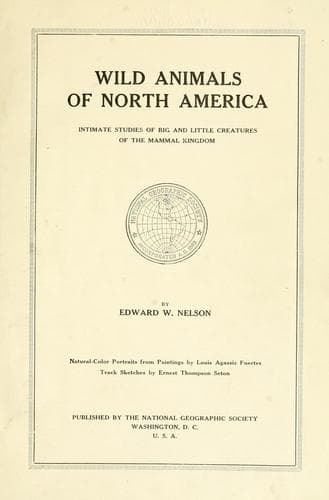
Wild Animals of North America: Intimate Studies of Big and Little Creatures of the Mammal KingdomNelson, Edward William
Science
Wild Animals of North America: Intimate Studies of Big and Little Creatures of the Mammal Kingdom
Nelson, Edward William
Mammals -- North America
Muskrats are usually harmless animals and their presence in marshes
and along watercourses lends a pleasant touch of primitive wildness to
the most commonplace situations. They appear to have so adapted their
habits to the presence of men that they go on with their affairs with
curious indifference to their human neighbors. In irrigated country
or elsewhere where banked ditches are built their habits render them
serious pests, as their burrows and tunnels drain ponds or cause
destructive washouts.
An interesting chapter in the history of these animals began in 1905,
when four Canadian muskrats were introduced on a nobleman’s estate
in Bohemia. Since then they have increased rapidly and spread over a
large area in Bohemia and beyond its borders. The streams in the region
they occupy are controlled by grassy banks, and dams are built to form
ponds for fish culture, which is a large industry there. The muskrats
persistently tunnel into the banks and dams, causing them to give way,
thus causing heavy losses to the owners.
They also work havoc among river crabs and mussels, which have great
economic value, and interfere with the fish and their spawning beds.
To cap the climax of their misdeeds, they are reported to feed on
grain and vegetables and to destroy the eggs of domestic poultry and
of wild-fowl. It is reported also that these expatriates in their
foreign environment have become larger animals than their ancestors,
and that their fur has greatly deteriorated in quality. The measures
prescribed by the Agricultural Council of the Kingdom of Bohemia for
their control are apparently without much success. This instance is a
good illustration of the danger attending the introduction of an animal
from its native habitat into a new region.
=THE WOODRAT= (=Neotoma albigula= and its relatives)
(_For illustration, see page 526_)
In the East known as woodrats, in the West, where much more numerous
and better known, these animals are called “mountain rats” or
“trade rats.” Despite a certain superficial resemblance in size and
appearance, woodrats are not related to those exotic parasites,
the house rats, with coarse hair and bare tails, but are far more
attractive and handsome animals, clothed in fine soft fur, delicately
colored above in soft shades of gray, buffy, or ferruginous, while
below they are usually snowy white or buffy. The tail is fully haired
and in some species almost as broad and bushy as that of a squirrel.
Their prominent black eyes and large ears give them an air of vivacious
intelligence which their habits appear to confirm.
Public-domain text, read in full here on John Shaqi.
Reviews
Reviews
No reviews yet
Be the first to share your thoughts on this work.
Elsewhere in the archive
Join the Discussion
Join the discussion
Sign in to leave a comment or review.
Sign InorCreate an account