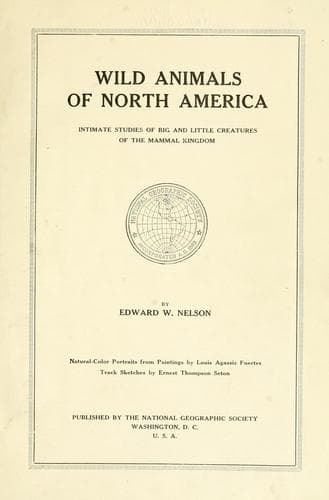
Wild Animals of North America: Intimate Studies of Big and Little Creatures of the Mammal KingdomNelson, Edward William
Science
Wild Animals of North America: Intimate Studies of Big and Little Creatures of the Mammal Kingdom
Nelson, Edward William
Mammals -- North America
Woodrats are peculiar to North America, where they occur from
Pennsylvania and Illinois to the Gulf coast, spreading thence to the
Pacific and as far north as the headwaters of the Yukon, and south
through Mexico and Central America to Nicaragua. They are not plentiful
in the southern Mississippi Valley and eastward, where they live among
cliffs and broken ledges of rock in the deciduous forests, and well
deserve their common name. In this region their presence is rarely
suspected except by hunters or others familiar with woodland life.
Far more numerous and widely known in the Western States and throughout
most of Mexico, they have adapted themselves to life under every
climatic condition, from the most sun-scorched deserts of the southwest
and the splendid redwood forests of the humid coastal region in
northern California to the tropical lowlands farther south.
They live nearly everywhere on the mountain slopes, even to timber-line
at 13,800 feet on Mount Orizaba. They thrive in an extraordinary
variety of situations, not only where they may find shelter among
rocks, but also where they must seek safety in nests made on the
surface of the ground or in burrows dug by themselves. They are
prolific animals and each year have several litters containing from two
to five young.
The presence of woodrats is generally indicated by accumulations of
odds and ends filling the crevices of the rocks about their retreats
or piled about the entrances of their burrows, such accumulations
including small sticks, pieces of bark, leaves, cactus burrs, bones,
stones, and any other small objects which may be found in the vicinity.
Sometimes these piles of fragments seem to be made merely for amusement
or to work off surplus energy, as they form useless gatherings, such as
heaps of small stones, frequently containing a bushel or more, piled
on the rounded tops of small protruding boulders in open desert areas,
or small heaps of sticks and other material scattered aimlessly about
their haunts.
In the desert where cactuses of many kinds abound woodrats’ nests are
often made at the bases of these or other thorny plants and are covered
with such a protective coating of cactus burrs as to deter the most
insistent enemy. In the heavy forests of northern California woodrats
build huge conical nests of sticks several feet in diameter on the
ground, rising to a height of five feet or more.
In southern California and elsewhere some species make great nests
of sticks eight to twenty feet from the ground in live oaks and
other trees. The stick-pile nests on the ground usually have several
entrances, with trails leading from them, and the underground burrows
usually have two or more openings.
Public-domain text, read in full here on John Shaqi.
Reviews
Reviews
No reviews yet
Be the first to share your thoughts on this work.
Elsewhere in the archive
Join the Discussion
Join the discussion
Sign in to leave a comment or review.
Sign InorCreate an account