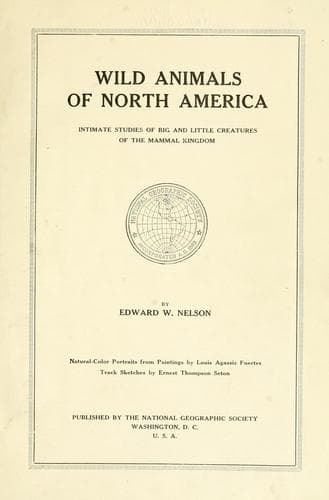
Wild Animals of North America: Intimate Studies of Big and Little Creatures of the Mammal KingdomNelson, Edward William
Science
Wild Animals of North America: Intimate Studies of Big and Little Creatures of the Mammal Kingdom
Nelson, Edward William
Mammals -- North America
Their activities are sources of mingled amusement and vexation. Small,
loose articles, including table knives, forks, and spoons, vanish and
all manner of trash, including horse droppings, are brought in, thus
establishing their title to the cognomen of “trade rats.” If the owner
of a cabin leaves it for a few days, he may find on his return that the
rats have taken possession and during his absence have tried to fill
it with trash of all kinds, in order to make a comfortable home for
themselves.
At one cabin in the mountains of New Mexico where I lived one summer
several mountain rats made free of the place and at night persistently
tried to add our shoes to their nest under the floor. An hour or so
after retiring we would hear our shoes scrape slowly across the floor,
and in the morning they would be found stuck toe down in the broad
crack where the floor ended near the wall. In the woodrat country when
small articles are missed from camp it is always worth the trouble to
investigate the nearest rats’ nests.
Woodrats are plentiful on the Mexican table-land, making their nests
under cactuses or thorny agaves, where they are persistently hunted as
game by the natives, who prize them as a special delicacy. I saw them
regularly sold in the markets of the cities of San Luis Potosi and
Aguas Calientes, where the method of marketing them was unique. As soon
as they were dug from their nests, their lower incisors were broken off
close to the jaw to render them powerless to bite, and then the rats
were placed alive in a strong sack and carried to town.
The vendor would sit on a curb at the market and either kill and dress
them there or shout his wares by telling every one who passed that he
had “country rats; very delicious; live ones; fat ones; very delicious;
very cheap.” The natives all praised their delicate flavor and one I
had served me as a special courtesy was really good, tasting like young
rabbit.
=THE HARVEST MOUSE= (=Reithrodontomys megalotis= and its
relatives)
(_For illustration, see page 527_)
In size, proportions, and color the harvest mice, of all our American
species, most closely resembles the common house mouse. Many of them
are decidedly smaller than that animal and they rarely, if ever, exceed
it in size. They may be distinguished from the house mouse by their
browner colors, more hairy tail and especially by a little groove which
extends down the front of each upper incisor.
The mice of this group include many species and have a wide
distribution ranging from Virginia, in the eastern United States, to
the Pacific, and from North Dakota, Montana, and Washington southward
through Mexico and Central America to northern South America.
They reach their greatest development in number and diversity of
species in the region about the southern end of the Mexican table-land,
where I have caught them from the tropical lowlands, near sea level, up
to an altitude of 13,500 feet, at timber-line, on Mount Iztaccihuatl.
Public-domain text, read in full here on John Shaqi.
Reviews
Reviews
No reviews yet
Be the first to share your thoughts on this work.
Elsewhere in the archive
Join the Discussion
Join the discussion
Sign in to leave a comment or review.
Sign InorCreate an account