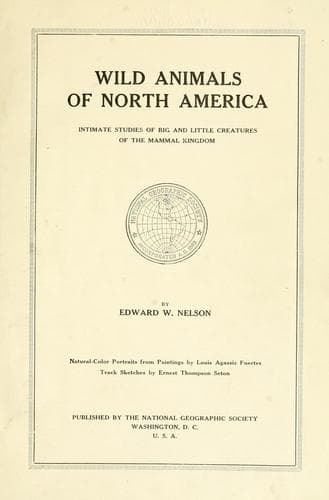
Wild Animals of North America: Intimate Studies of Big and Little Creatures of the Mammal KingdomNelson, Edward William
Science
Wild Animals of North America: Intimate Studies of Big and Little Creatures of the Mammal Kingdom
Nelson, Edward William
Mammals -- North America
Some of their bush nests three or four feet from the ground were found
when I was hunting on El Mirador coffee plantation in Vera Cruz. Often
on approaching them, the single occupant would dive headlong into the
grassy cover below and disappear. But sometimes when disturbed they
would come out and run about through the tops of the bushes, leaping
from branch to branch with all the agility and graceful abandon of
pigmy squirrels. Several times they were seen to stop and sit crosswise
on the branches with their tails hanging straight down. When they move
about among the branches they sometimes coil the tail around the twig
as an opossum might, to give them a more certain hold.
While harvest mice may be seen at their nests by day, they are mainly
crepuscular and nocturnal, and so retiring in habits that their
presence may be entirely overlooked unless special search is made to
locate them. Where found their pretty ways well repay the observer who
has the patience to spend a little time with them.
=THE GRASSHOPPER MOUSE= (=Onychomys leucogaster= and its
relatives)
(_For illustration, see page 527_)
The grasshopper mice are notable for the delicate coloring and velvety
quality of their fur. While closely resembling some of the white-footed
mice, they may readily be distinguished from them by more robust form,
short, thick tail, and the character of the fur.
Only two species, each with numerous geographic races, are known and
both are peculiar to North America. Characteristic animals of the
arid and semi-arid treeless plains, plateaus, and foothills of the
West, their known range extends from Minnesota and Kansas west to
the Cascades and to the Pacific coast of southern California, and in
the North, from the plains of the Saskatchewan southward to San Luis
Potosi, on the tableland of Mexico.
Some races live on the grassy plains west of the Mississippi, but
the majority prefer the looser soil and sandy areas of the more arid
Great Basin and the even more desert Southwest, where the vegetation
is characterized by a scattered growth of woody plants, including many
species of cactuses, yuccas, agaves, sagebrush, greasewood, mesquites,
acacias, and other picturesque types.
Like other small mammals of the open plains, the grasshopper mice live
in burrows. When opportunity offers they evade the labor of digging
these for themselves by occupying the deserted holes of mice, kangaroo
rats, ground squirrels, prairie dogs, badgers, and other animals. In
these retreats they have nests of soft vegetable matter and each season
bring forth several litters containing from two to six young.
They are active throughout the year, but nothing appears to be known as
to the kind and amount of stores they lay up for winter use. As many
live far enough north to experience a long period of cold, with snow
covering the earth, there is little doubt that they exercise the same
provision in providing stores to meet the need as do many other small
mammals.
Public-domain text, read in full here on John Shaqi.
Reviews
Reviews
No reviews yet
Be the first to share your thoughts on this work.
Elsewhere in the archive
Join the Discussion
Join the discussion
Sign in to leave a comment or review.
Sign InorCreate an account