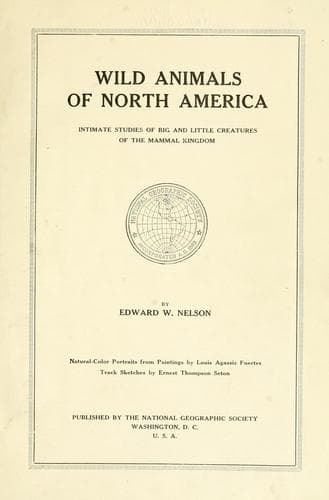
Wild Animals of North America: Intimate Studies of Big and Little Creatures of the Mammal KingdomNelson, Edward William
Science
Wild Animals of North America: Intimate Studies of Big and Little Creatures of the Mammal Kingdom
Nelson, Edward William
Mammals -- North America
Many species of mice eat insects or meat and even on occasion devour
one of their own kind. The grasshopper mice go far beyond this and are
often not only as fierce flesh eaters as real carnivores, but make
their diet, at least during the summer season, mainly of insects and
other small invertebrates. Their bill of fare includes a miscellaneous
assortment of several species of mice, including their own kind caught
in traps, small dead birds, lizards, frogs, cutworms, scorpions, mole
crickets, ordinary crickets, grasshoppers, moths, flies, and beetles,
including the “potato bug.”
In addition they eat many kinds of seeds, fruit, and other vegetable
matter. Where obtainable, grasshoppers are one of their favorite foods,
and from this they receive their common name. In Colorado, from their
fondness for scorpions, they are sometimes called “scorpion mice.”
Vernon Bailey’s observations of a grasshopper mouse he had in captivity
are illuminating as to their habits, and indicate that their presence
in numbers about cultivated land must be of distinct economic value.
When undisturbed and well fed the captive was entirely nocturnal,
sleeping all day and becoming very active at night. While usually
quiet, sometimes jumping with all his force he tried furiously to
escape from his small prison box. His favorite food consisted of
crickets, grasshoppers ranking next. Among other things he ate were a
black beetle, ladybirds, a potato beetle, spiders, bugs, and dragon
flies.
In feeding he sat upright on his haunches and held the insects in his
front paws, eating them head first. Large grasshoppers, their tails
resting on the ground, were held head up by a paw on each shoulder. A
grasshopper would sometimes kick so vigorously as to tip the mouse off
its balance, but was never relinquished until decapitated.
The mouse promptly killed and ate a small frog placed in his box and
was expert at catching flies. He ate many kinds of insects, including a
live wasp, but appeared terror-stricken if a few ants were put in with
him. When a dozen or more crickets and grasshoppers were put into his
box at the same time he at once proceeded to bite off all their heads
before beginning to feast upon them.
A dead white-footed mouse was dropped in and “he pounced upon it like a
cat, caught it by the side of the head near the ear, and began biting
it with all the ferocity of a coon dog.” The bones could be heard
cracking and after the little beast appeared satisfied that his prey
was really dead he ceased worrying it and an examination showed that
he had bitten through its skull deep into the brain. Afterward he tore
off and ate fragments of flesh from its head, neck, and shoulders. The
ferocious certainty with which he seized the white-footed mouse by the
head and bit through its skull indicated that in relation to small
mammals he, probably like all his kind, had the predatory instincts and
habits of the carnivores.
Public-domain text, read in full here on John Shaqi.
Reviews
Reviews
No reviews yet
Be the first to share your thoughts on this work.
Elsewhere in the archive
Join the Discussion
Join the discussion
Sign in to leave a comment or review.
Sign InorCreate an account