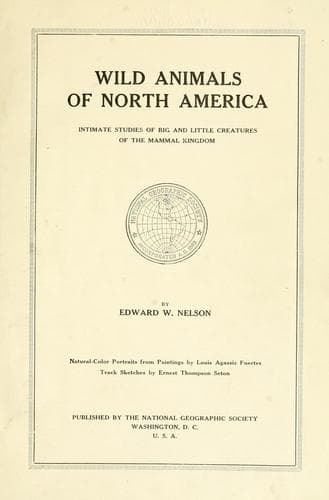
Wild Animals of North America: Intimate Studies of Big and Little Creatures of the Mammal KingdomNelson, Edward William
Science
Wild Animals of North America: Intimate Studies of Big and Little Creatures of the Mammal Kingdom
Nelson, Edward William
Mammals -- North America
White-footed mice feed mainly on many kinds of seeds and nuts and vary
this diet with snails, insects, and sometimes with the flesh of dead
birds or other mice. As they do not hibernate they lay up abundant
stores of grain and seeds of many kinds in addition to a variety of
nuts, as acorns, beech nuts, pine nuts, maple seeds, and others,
according to the locality. The stores are hidden in hollows in logs,
stumps, trees, or in the ground. When in captivity they have shown
themselves expert in catching flies, sometimes capturing them with
their teeth and again with their front paws used with all the dexterity
of little hands.
Several litters of young containing from three to seven each are
born, the first usually appearing in spring and the last in fall. The
young are blind and helpless at birth, and in this condition cling so
tenaciously to the mother’s teats that when she is frightened from the
nest they are often carried off attached to her.
Some individuals at least of the white-footed mice, like others of the
genus Peromyscus, are known to have a prolonged and musical song. It
is a fine warbling ditty, a little like the song of a canary. A number
of good observers have recorded these performances, but they appear to
be so infrequent that most people with woodland experience have never
heard them.
The lives of these mice are passed in constant fear of a host of
enemies. Hawks and owls, bluejays, and shrikes in the bird world are
ever on the alert to capture them, while skunks, weasels, minks, foxes,
and snakes persistently seek them in their retreats.
=THE BEACH MOUSE= (=Peromyscus polionotus niveiventris= and
its relatives)
(_For illustration, see page 530_)
The beach mouse is a beautiful, velvety-furred little creature about
the size of a house mouse and one of the smallest species of the
genus Peromyscus. Its back is colored with delicate shades of pale
vinaceous-buffy and its underparts, including the feet, are snowy white.
The species _Peromyscus polionotus_, of which the beach mouse is one
of several geographic races, or subspecies, occupies a comparatively
restricted range in the lowland region of Alabama and Georgia and
thence through a large part of Florida.
It presents an unusually convincing illustration of the influence of
changing environment upon the physical characters of animals. Among
the cotton fields of Alabama and Georgia _Peromyscus polionotus_ is
rather dark grayish brown, but on the lighter-colored soil of Florida
the color responds and becomes paler in perfect correspondence with
the change in soil until the white sand-dunes and beaches of the coast
are reached. There, in strong contrast with the color of the northern
members of the species, it is so modified that the pale representatives
of this area are recognized under the name _niveiventris_, as a
geographic race, or subspecies.
Public-domain text, read in full here on John Shaqi.
Reviews
Reviews
No reviews yet
Be the first to share your thoughts on this work.
Elsewhere in the archive
Join the Discussion
Join the discussion
Sign in to leave a comment or review.
Sign InorCreate an account