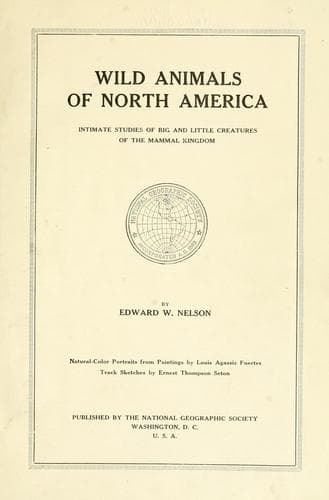
Wild Animals of North America: Intimate Studies of Big and Little Creatures of the Mammal KingdomNelson, Edward William
Science
Wild Animals of North America: Intimate Studies of Big and Little Creatures of the Mammal Kingdom
Nelson, Edward William
Mammals -- North America
Changes in environment affect both great and small mammals in a variety
of ways, sometimes in shades of color, sometimes in relative size,
and sometimes in proportions. Exceptions to the rule are to be found,
however, and some species of mammals have a wide range under a great
variety of conditions, with scarcely an appreciable sign of variation.
The beach mouse is abundant on the sand-dunes and beaches of peninsular
Florida, especially from Palm Beach to Mosquito Inlet, wherever there
is a growth of sea oats (_Uniola_), which appears to be its principal
food plant. It is a nocturnal animal and its nightly activities may be
read, early in the morning, from the multitude of tiny tracks which
lead in all directions and often form a network on the sand. A single
track sometimes extends for a hundred yards or more from a burrow, and
with all its windings may aggregate several hundred yards of travel,
showing the activity of this small worker during many hours.
Tracks are most plentiful immediately about growths of sea oats,
patches of saw palmetto, or scrubby bushes. The homes of these mice
are usually in short burrows sheltered by growing vegetation or under
fallen palm fronds.
As in the case of many of our mammals, we have scanty information
concerning the life of these attractive little animals, and it is
suggested that here lies a pleasant subject for investigation by some
nature lover wintering in Florida.
=THE BIG-EARED ROCK MOUSE= (=Peromyscus truei= and its
relatives)
(_For illustration, see page 531_)
The numerous species of mice of the genus Peromyscus in North
America include a great variety of little beasts, many of which are
distinguished by beauty of form and color. One of the most striking and
picturesque individualities among these is found in the big-eared rock
mouse, which is characterized by its great ears, a thick, soft coat
of buffy brown fur, and a long, well-haired tail. In size it exceeds
the common house mouse and even the white-footed mice which share its
haunts.
This rock mouse is indigenous to the mountainous regions of the West,
from Colorado and New Mexico to the Pacific and south to the Cape
Region of Lower California, and down the Sierra Madre of Mexico to
Oaxaca. Within this area it divides into several not very strongly
marked geographic races.
As implied by its common name, it is a characteristic dweller among
cliffs and ledges along the mountain slopes or rocky canyon walls,
where it occupies the many crevices and little caves. In California it
ranges from near sea-level up on the mountains to above 10,000 feet
altitude. Although showing a distinct preference for rocky places,
when available, some races of this mouse adapt themselves to other
conditions and may be found on brush-grown flats, where they live in
brush heaps, old wood-rat nests, and similar shelter.
Public-domain text, read in full here on John Shaqi.
Reviews
Reviews
No reviews yet
Be the first to share your thoughts on this work.
Elsewhere in the archive
Join the Discussion
Join the discussion
Sign in to leave a comment or review.
Sign InorCreate an account