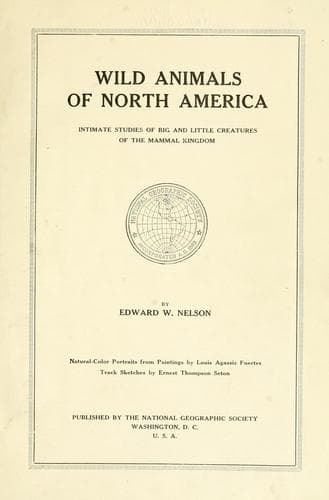
Wild Animals of North America: Intimate Studies of Big and Little Creatures of the Mammal KingdomNelson, Edward William
Science
Wild Animals of North America: Intimate Studies of Big and Little Creatures of the Mammal Kingdom
Nelson, Edward William
Mammals -- North America
The brown rat is believed to have first invaded Europe from Asia in
1727, when hordes of them swam the Volga River, and about the same year
it arrived in England on ships from the Orient. Since then, traveling
by ships and by inland commercial routes, it has spread to nearly all
parts of the globe. In America it is now established in human abodes
throughout the length and breadth of the continents from Greenland to
Patagonia.
Wherever it goes the fierce and aggressive spirit with which it is
endowed qualifies the brown rat more than to hold its own against all
rivals, while its mental adroitness and its fecundity have largely
nullified the constant warfare being waged against it by all mankind.
Not content with infesting ships, dwellings, stores, warehouses, and
even the refrigerating rooms of cold-storage plants in many areas, it
has established itself as an extremely destructive pest in the open
fields.
[Illustration: MUSKRAT
_Fiber zibethicus_]
[Illustration: WOOD RAT
_Neotoma albigula_]
In towns it hides among stored merchandise, in the hollow walls of
buildings, in sewers and other underground passages, or, as in the
fields, in burrows which it digs in the ground. Its nests are
soft, warm masses of fibrous material which is secured by raids on
any available supply of cotton, wool, or fabrics, which they cut into
shreds for the purpose.
[Illustration: HARVEST MOUSE
_Reithrodontomys megalotis_]
[Illustration: GRASSHOPPER MOUSE
_Onychomys leucogaster_]
In these retreats it has several litters a year, averaging about ten
young, but exceptional cases of more than twenty young have been
recorded. The young begin to breed when less than six months old. The
size and number of litters increase with the food supply, and under
favorable conditions rats soon become intolerable pests.
In Jamaica and the Hawaiian Islands rats became so numerous that
sugar-cane and other plantations were at one time threatened with
complete destruction. To save the crops the mongoose was introduced,
but after checking the rats in Jamaica these curious little mammals in
turn became a pest which it appears hopeless to control.
In the Hawaiian Islands the mongoose reduced the number of rats, but
the survivors promptly took up their abodes in the tree tops, where
they now live as completely arboreal lives as squirrels, safe from
their ground-inhabiting enemy.
During a two weeks’ campaign against rats in the sewers of Paris
600,000 were killed, and on a rice plantation of about 1,200 acres in
Georgia 30,000 were destroyed in one season. In Illinois 3,435 were
killed on a farm in one month.
Public-domain text, read in full here on John Shaqi.
Reviews
Reviews
No reviews yet
Be the first to share your thoughts on this work.
Elsewhere in the archive
Join the Discussion
Join the discussion
Sign in to leave a comment or review.
Sign InorCreate an account