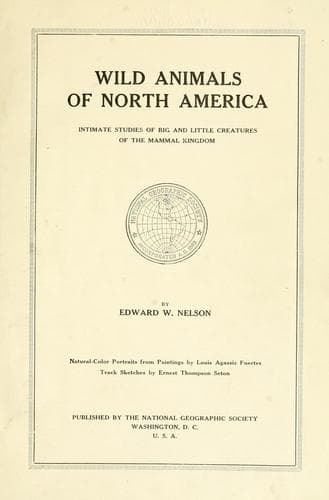
Wild Animals of North America: Intimate Studies of Big and Little Creatures of the Mammal KingdomNelson, Edward William
Science
Wild Animals of North America: Intimate Studies of Big and Little Creatures of the Mammal Kingdom
Nelson, Edward William
Mammals -- North America
One of the most curious chapters in the life of this hardy beast is
now developing in the far island of South Georgia, on the border of
the Antarctic, east of Cape Horn. On this island, which has a cold
and stormy summer and nine months of rigorous winter, several whaling
stations have been established. For years great numbers of whale
carcasses have drifted ashore each season and, half rotting, half
refrigerated, have furnished a never-failing food supply for brown
rats that have landed from the ships. With such abundant food they are
reported to have increased until they now exist there literally in
millions. They make their nests in the tussocks of grass and peat and
swarm along well-marked trails they have made on the mountain sides.
In the trenches along the battle front in France they have become
extremely abundant and troublesome, and in England have multiplied
until the Board of Agriculture is recommending efforts to destroy them
as a menace to the public welfare through their waste of food supplies.
On farms, in addition to destroying growing and stored crops, they kill
great numbers of young chickens, turkeys, and other poultry, and create
havoc with such ground-frequenting game as pheasants. At all times
brown rats are more or less carnivorous, and when several are confined
in a cage the stronger will soon kill and devour the weaker.
In city department stores and large hotels they often cause thousands
of dollars damage yearly in single establishments. An English
organization for their destruction estimated in 1908 that, outside the
towns and shipping, in Great Britain and Ireland they caused annual
losses of about $73,000,000.
When there is a sudden diminution in the food supply, an abundance
of which has caused a great increase in the rat population, the rats
migrate into other districts, sometimes in enormous numbers. These
migrations usually occur at night, and many are matters of history in
Europe and in the United States.
A witness of one of these migrations in Illinois in 1903 reported
that one moonlight night as he was passing along the roads he heard a
rustling in a field near by and soon saw crossing the road in front of
him a multitude of rats extending as far as he could see. The following
year the invaders became a plague in that district. At times of food
scarcity rats become extremely bold and aggressive. Without hesitation
they swim streams encountered in their wanderings and at times will
even attack man.
Owing to their great numbers, universal distribution, and
destructiveness, brown rats are the worst mammal pest known to
mankind. Through their habit of living in sewers, among the offal
of slaughter-houses, and in garbage heaps, from which they invade
dwellings and storehouses, they pollute and spoil even more foodstuffs
than they eat.
Public-domain text, read in full here on John Shaqi.
Reviews
Reviews
No reviews yet
Be the first to share your thoughts on this work.
Elsewhere in the archive
Join the Discussion
Join the discussion
Sign in to leave a comment or review.
Sign InorCreate an account