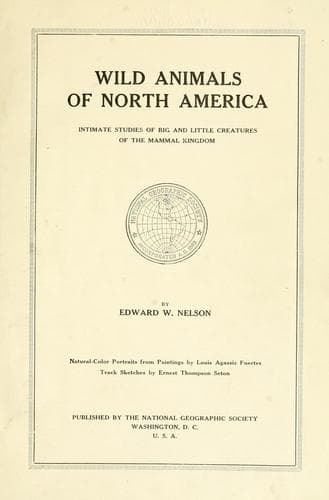
Wild Animals of North America: Intimate Studies of Big and Little Creatures of the Mammal KingdomNelson, Edward William
Science
Wild Animals of North America: Intimate Studies of Big and Little Creatures of the Mammal Kingdom
Nelson, Edward William
Mammals -- North America
In addition, they are known carriers of some of the worst and most
dreaded diseases, as bubonic plague, trichinosis, and septic pneumonia;
while there is little doubt that they spread scarlet fever, typhoid,
diphtheria, and other contagious maladies. Bubonic plague is mainly
dependent upon rats for its dissemination and has been carried by
them to more than fifty countries, including the United States. In
India more than two million people have died in one year from this
rat-conveyed disease.
Although rats are abhorred by man, yet they have been for ages so
closely associated with most of his activities that they have long
had their place in Old World literature. Among other instances, many
readers will recall Victor Hugo’s gruesome account of Jean Valjean’s
fight with the rats in the sewers of Paris. In England and on the
continent rat catching has been a regular trade and dogs have been
specially bred for use in their pursuit.
Rats are loathsome vermin which civilized man should eliminate with the
other evils of his semi-barbaric days which he is leaving behind. One
might still wish that in many places a modern “Pied Piper of Hamelin”
would appear and rid the people of these pests. This is not necessary,
however, if the public will cease to take their presence as a matter
of course. Their exclusion from buildings and destruction are merely
matters of good housekeeping, both personal and communal.
Rats can be banished by removing or destroying trash heaps and similar
harboring places and by the simple expedient of rat-proofing buildings,
especially dwellings, granaries, warehouses, and other places where
food supplies are stored.
These precautionary measures should be supplemented by trapping
or poisoning in open places. Campaigns of this kind can be fully
successful only when engaged in by the community at large. The returns
from the investment for such a purpose will be large, not only in the
vast money values of property saved, but in the reduction of the death
rate and in the great improvement of the public health.
THE HOUSE MOUSE (Mus musculus)
(_For illustration, see page 531_)
The familiar house mouse is of Old World origin and may be
distinguished from most of our native mice by its proportionately
slenderer body, long hairless tail, and the nearly uniform color on the
upper and under parts of the body. Like the house rat, wandering an
alien from its original home in Asia, and transported by ship and by
inland commerce, it has gained permanent foothold and thrives in lands
of the most diverse climatic conditions, except those of the frigid
polar regions.
Public-domain text, read in full here on John Shaqi.
Reviews
Reviews
No reviews yet
Be the first to share your thoughts on this work.
Elsewhere in the archive
Join the Discussion
Join the discussion
Sign in to leave a comment or review.
Sign InorCreate an account