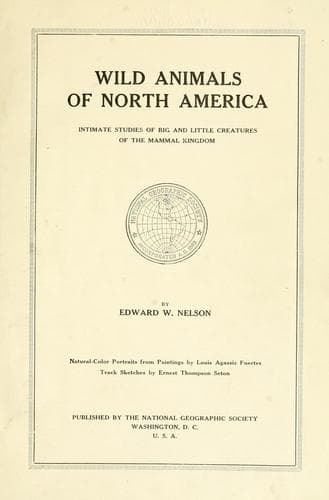
Wild Animals of North America: Intimate Studies of Big and Little Creatures of the Mammal KingdomNelson, Edward William
Science
Wild Animals of North America: Intimate Studies of Big and Little Creatures of the Mammal Kingdom
Nelson, Edward William
Mammals -- North America
For centuries the house mouse has been parasitic about the habitations
of man, and in many places in America has spread into the surrounding
country, where it holds its own in the struggle for existence with
many of our native species. It is probable that its ability to live
in houses also infested by the fierce brown rat is due wholly to its
agility, and to the small size, which enables it to retreat through
crevices too small for the rat.
In buildings it hides its warm nests in obscure nooks and crannies,
making them of scraps of wool, cotton, or other soft fibrous material,
often cut from fabrics. Out in the fields, like any other hardy
vagabond, it adapts itself to whatever cover may be available on the
surface or in crevices and the deserted burrows of other mammals.
It has several litters of from four to nine young each year. The young
are born blind, naked, and helpless, but are soon able to run about,
often following the mother on her foraging expeditions. When a little
more than half grown they usually scatter from the home nest and seek
locations of their own.
Throughout most of its world-wide range the house mouse has the same
general appearance, but in some localities the effect of changed
environment is developing appreciable differences, which appear
destined to result in marked geographic races. The representatives of
these mice I caught in weedy fields on the coast of Chiapas, near the
border of Guatemala, have an appreciable rusty shade on the back in
place of the ordinary dull gray.
The success of both the house mouse and the house rat in establishing
themselves so successfully in all parts of the world, in the face of
the antagonism of mankind, affords marvelous examples of physical and
mental adaptability not equaled elsewhere among mammals.
From early days the domestic mouse has been a familiar member of the
household with people of all degree, and the housewife has had to match
her wits against the cunning persistence of this small marauder in
order to safeguard the family supplies of food and clothing.
Despite the antagonism excited by its destructive habits the mouse is
so small and often so amusing in its ways that it has commonly been
regarded with a half hostile, half friendly, interest. This is apparent
by frequent references to it in proverbs, nursery rhymes, fables, and
folklore, as well as in more serious literature.
Many cases of singing house mice have been recorded, their notes being
a series of continuous musical chirps, trills, and warblings, rising
and falling about an octave and slightly resembling the song of a
canary. It has been claimed that this singing is due to an affection of
the songster’s breathing organs, but this can scarcely account for its
being uttered at definite times and places and ceasing at the volition
of the performer.
Public-domain text, read in full here on John Shaqi.
Reviews
Reviews
No reviews yet
Be the first to share your thoughts on this work.
Elsewhere in the archive
Join the Discussion
Join the discussion
Sign in to leave a comment or review.
Sign InorCreate an account