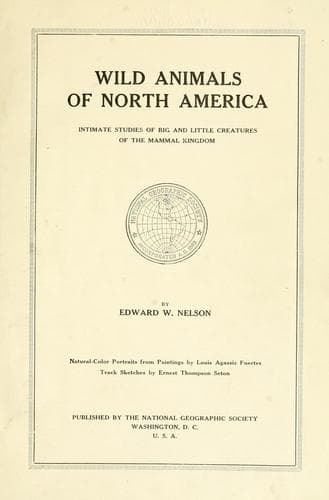
Wild Animals of North America: Intimate Studies of Big and Little Creatures of the Mammal KingdomNelson, Edward William
Science
Wild Animals of North America: Intimate Studies of Big and Little Creatures of the Mammal Kingdom
Nelson, Edward William
Mammals -- North America
In one instance the song had been heard in a china closet and an
observer sat by the open door to locate the singer. After patient
waiting “a mouse peered out from behind the plates, climbed up a little
way on the brackets, and after looking around several times, began to
sing.” This mouse continued to sing in the same place at intervals for
several weeks and became accustomed to the presence of people during
its performances; then it suddenly disappeared, probably a victim to
one of the dangers which constantly beset its kind.
=THE MOUNTAIN-BEAVER= (=Aplodontia rufa phaea= and its
relatives)
(_For illustration, see page 534_)
The first adventurous fur traders who penetrated the Oregon wilds
found the Chinook Indians provided with robes made of skins of the
mountain-beaver. From that time until recently but little accurate
information has been available concerning the habits of this curious
animal. Locally it is known by several other names, including
“Sewellel,” “mountain boomer,” “boomer,” and, in the Olympic mountains,
“chehalis.”
The genus of mountain-beavers contains only a single species with
several subspecies, all having a close superficial likeness in size
and form to a tailless muskrat, except for their coarse, harsh fur.
It is an exclusively North American type and, aside from a remote
relationship to the squirrel family, has no kin among living mammals.
It appears to be a sole survivor from some former age. As with the
pocket gophers, its mode of life has developed powerful muscles about
the head, front legs, and forepart of the body.
The distribution of the mountain-beaver in Tertiary times extended
through the Great Basin to North Dakota, but at present is closely
restricted to the humid region between the crests of the Cascades and
the Sierra Nevada and the Pacific coast, and from the lower Fraser
River, British Columbia, south to the latitude of San Francisco Bay,
California.
[Illustration: WHITE-FOOTED MOUSE (Adult and Young)
_Peromyscus leucopus_]
[Illustration: BEACH MOUSE
_Peromyscus polionotus niveiventris_]
Within this superbly forested region this animal delights in
locations that are cool and oozing with water, where, under the dense
shade of an almost tropical undergrowth of shrubs, ferns, and other
herbage, it constructs numberless tunnels and trails. These are
sometimes in flats, but much more often along canyons and mountain
slopes, among willow, alder, aspen, or other thickets, or even in the
heavy coniferous forest.
[Illustration: BIG-EARED ROCK MOUSE
_Peromyscus truei_]
[Illustration: BROWN RAT
_Rattus norvegicus_
HOUSE MOUSE
_Mus musculus_]
Public-domain text, read in full here on John Shaqi.
Reviews
Reviews
No reviews yet
Be the first to share your thoughts on this work.
Elsewhere in the archive
Join the Discussion
Join the discussion
Sign in to leave a comment or review.
Sign InorCreate an account