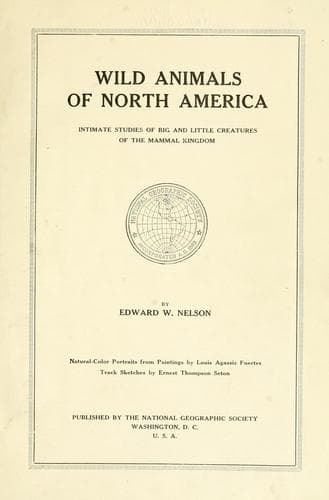
Wild Animals of North America: Intimate Studies of Big and Little Creatures of the Mammal KingdomNelson, Edward William
Science
Wild Animals of North America: Intimate Studies of Big and Little Creatures of the Mammal Kingdom
Nelson, Edward William
Mammals -- North America
Veritable colonies inhabit certain areas and the ground is honeycombed
with burrows six to eight inches in diameter and covered with a network
of surface trails. The irregular branching tunnels are sometimes two
or three hundred feet in length and have at frequent intervals side
passages through which the earth mined in extending the burrow may be
ejected in small dumps. The tunnels appear in a large measure built for
the safety of the owner in traveling, since they repeatedly come to the
surface at the end of a log, where an open, neatly kept trail extends
under its shelter the entire length, the tunnel being resumed at the
far end of the log.
All surface runways connecting tunnel entrances or leading through the
thick surface vegetation are well kept and free of all obstructions.
The ground in these haunts is commonly so saturated with water that the
tunnels form drainage channels down which run little streams.
Nest chambers discovered by T. H. Scheffer in the Olympic Mountains
were located in tunnels two feet underground. They were oval in form
and one measured eighteen inches in horizontal diameter and seventeen
in height. Here three storage chambers opened directly from the nest
chamber, one of which contained two quarts or more of sections of fern
roots, which had been kept so long they were spoiled, and another was
partly filled with freshly cut leaves of nettles and twigs of cedar
and fir. At the far end an opening dropped six inches into a small
drainage basin partly filled with water, out of which led two passages.
The roofs of the chambers were lined with a thin layer of clay, which
appeared to have been packed in place by the owner.
In the upper and drier part of the nest, which was made of dried fronds
of ferns, grasses, and small twigs, were found three young less than
a week old, with coats of fine fur, but with eyes still closed. Like
burrowing animals generally, the mountain-beaver is cleanly in its
housekeeping, and offal, loose dirt, and debris of all kinds are pushed
out by the forefeet and head to the dumps at the less-used openings.
In winter much of the mountain-beaver country is buried under several
feet of snow, but this does not stop the activities of this hardy
animal. Between the entrances to its burrows and out along the surface
of the ground it tunnels through the snow in various directions in
search of forage.
At this time it cuts twigs from bushes and gnaws the bark from the
trunks and roots of the smaller trees, sometimes completely girdling
and killing trees more than two feet in diameter. Its underground
tunnels are also extended at this season, the soils being pushed up
in dumps under the snow and parts of the snow tunnels are packed full
of it for some distance, so that when the snow disappears the curious
earth-forms remain like those of the pocket gopher.
Public-domain text, read in full here on John Shaqi.
Reviews
Reviews
No reviews yet
Be the first to share your thoughts on this work.
Elsewhere in the archive
Join the Discussion
Join the discussion
Sign in to leave a comment or review.
Sign InorCreate an account