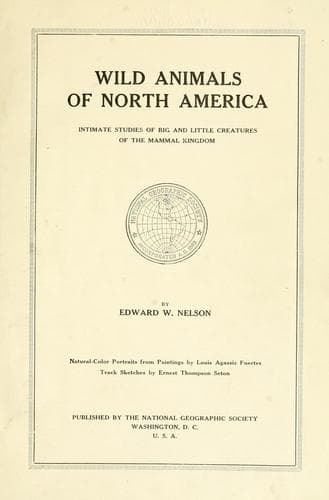
Wild Animals of North America: Intimate Studies of Big and Little Creatures of the Mammal KingdomNelson, Edward William
Science
Wild Animals of North America: Intimate Studies of Big and Little Creatures of the Mammal Kingdom
Nelson, Edward William
Mammals -- North America
The mountain-beaver lives a monotonous existence and correspondingly
lacks the mental vivacity of many other species which have a greater
freedom of movement. When one is caught it shows little fear, but
struggles to escape, growling, clattering its teeth, and biting
viciously at anything within reach. Its desire for food, however,
appears to control its emotions, and very soon after being captured it
will eat any green vegetation offered, as unconcernedly as though free.
That the mountain-beaver possesses social instincts is evident, as a
pair is often found occupying one set of tunnels, and in many favorable
places a number will have their burrows closely grouped and connected
with a network of communicating surface trails.
Although mainly nocturnal, the animals are active early in the morning
and late in the afternoon, as well as throughout dark days. Those kept
in captivity would show periods of restless activity at night and have
alternating periods of sleep and wakefulness during the day. Sometimes
they would sleep coiled with the head turned under the body and again
flat on their backs. During these periods their sleep is often so
profound that they may be handled without being awakened.
One captive animal is reported to have uttered a curious quavering note
resembling that of a screech-owl. They have a strong musky odor, which
is very evident when they are first caught, and which is frequently
apparent about the burrows.
Careful and repeated efforts to keep these animals in captivity
under as near normal conditions as possible in regard to food and
surroundings in the vicinity of where they were captured have, up to
the present time, resulted in failure. In every case the animals failed
to thrive and soon died.
The mating occurs about the middle of March, and a month later litters
of two or three young are born. The young grow slowly, not attaining
full size for a year or more, and do not breed until the second year,
but they leave the shelter of the home nest and scatter to occupy
burrows of their own at the end of the first two or three months.
The mountain-beaver feeds upon nearly all small vegetation growing in
its haunts, including, in addition to small herbage, shrubs, the bark
of trees and bushes, ferns, and fern roots. More than thirty species of
native plants have been found among its “hay” piles at the mouths of
burrows. Since its country has become increasingly occupied by farmers,
it has developed a fondness for cultivated crops that, in many places,
is rendering it a pest. It appears to have a special taste for cabbage,
potato, and onion tops, and other garden produce.
Public-domain text, read in full here on John Shaqi.
Reviews
Reviews
No reviews yet
Be the first to share your thoughts on this work.
Elsewhere in the archive
Join the Discussion
Join the discussion
Sign in to leave a comment or review.
Sign InorCreate an account