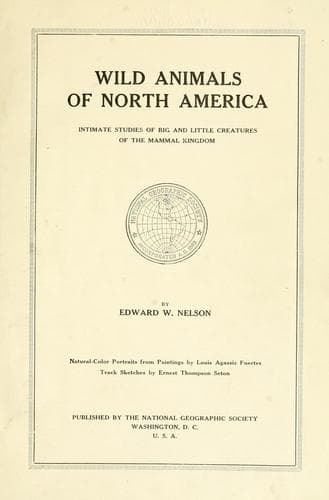
Wild Animals of North America: Intimate Studies of Big and Little Creatures of the Mammal KingdomNelson, Edward William
Science
Wild Animals of North America: Intimate Studies of Big and Little Creatures of the Mammal Kingdom
Nelson, Edward William
Mammals -- North America
When gathering its food it sits up squirrel-like and grasps the plant
stem with one hand, a long projecting tubercle on the “heel” of the
hand opposing the fingers like a thumb and giving a good grasp, so that
it can pull plants down to be bitten off with the sharp front teeth.
Sometimes it climbs up a few feet into a bush or small branching tree
after succulent shoots.
The mountain-beaver has the interesting habit of gathering stores of
green plant food much like that of the cony on the mountain tops,
but appears to be more methodical in its ways, gathering the stems
of such plants as grasses, ferns, and lupins, as well as twigs of
various bushes and carrying them in bundles as large as can be held in
the mouth, the butts of the stems neatly laid together. These little
bundles of “hay” are placed side by side about the entrances of the
burrows, with the butts all parallel on sticks or other support to keep
them as clear as possible from the ground. They are left thus for a day
or more to cure before being carried into the subterranean store-rooms.
Chief among the four-footed enemies of the mountain-beaver are the
fisher and bobcat, and an eagle has been seen keeping close watch at
the entrance of their burrows.
=THE COMMON WOODCHUCK, OR AMERICAN MARMOT= (=Marmota monax=
and its relatives)
(_For illustration, see page 534_)
The woodchuck or “groundhog” is a typical marmot, with coarse hair,
heavy body, short neck, short, bushy tail, powerful legs, and feet
armed with strong claws for digging. When fully grown it averages about
ten pounds in weight. Its usual color is a grizzled brown, but in some
districts black, or melanistic, individuals are not uncommon.
Marmots are common to Europe, Asia, and North America. The group
contains many species and geographic races varying in size and color.
The Alpine marmot of Europe is probably the most familiar of the Old
World species and the woodchuck the best known in America.
North America contains several species of marmots, their joint
territory extending from coast to coast over the northern parts of the
continent and from southern Labrador, the southern shores of Hudson Bay
and Great Slave Lake, and central Alaska southward to northern Alabama,
and along the high mountains to New Mexico and the southern Sierra
Nevada of California. The common woodchuck is well known to every
dweller in the countryside of the Eastern States and Canada, where it
occurs from sea-level to near the tops of the highest mountains, at
altitudes of over 4,000 feet.
Public-domain text, read in full here on John Shaqi.
Reviews
Reviews
No reviews yet
Be the first to share your thoughts on this work.
Elsewhere in the archive
Join the Discussion
Join the discussion
Sign in to leave a comment or review.
Sign InorCreate an account