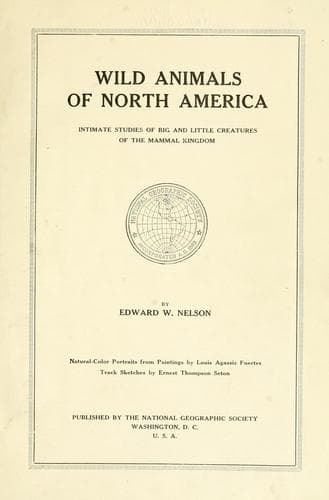
Wild Animals of North America: Intimate Studies of Big and Little Creatures of the Mammal KingdomNelson, Edward William
Science
Wild Animals of North America: Intimate Studies of Big and Little Creatures of the Mammal Kingdom
Nelson, Edward William
Mammals -- North America
It is a familiar habitant of fields and grassy hillsides, especially
where bordering woodland offers safe retreat. In such places it digs
burrows under stone walls, rocks, ledges, old stumps, or even out in
the open grass-grown fields. It commonly lives in the midst of the
forest, where its dens are located in a variety of situations. The
burrows are marked by little mounds of earth at the entrances and
ordinarily contain from twenty to forty feet of branching galleries,
one or more of which end in a rounded chamber about a foot in diameter,
well lined with dry grass and leaves.
Within these warm nests the females bring forth from three to nine
blind and helpless young about the last of April or early in May. A few
weeks later the young appear about the entrance of the burrows sunning
themselves and playing with one another, but usually ready to disappear
at the first alarm. At times, however, they are surprisingly stupid
and may be captured with ease. Woodchucks have practically no economic
value. Their flesh, while occasionally eaten, is little esteemed, and
their coarsely haired pelts are worthless as fur.
The woodchuck is a sluggish and stupid animal, which does not
ordinarily go far from its burrow, but at certain seasons, especially
in spring, wanders widely, as though looking over its territory before
locating for the summer. It has much curiosity and often sits upright
on its hind feet to look about, remaining for a long time as motionless
as a statue. When one is driven into its burrow, if a person approaches
quietly and whistles, it will often raise its head in the entrance and
look about to satisfy its curiosity.
Its only note is a short shrill whistle, which it utters explosively at
frequent intervals when much alarmed. At such times it also chatters
its teeth with a rattling sound as owls sometimes clatter their beaks.
Owing to their mainly diurnal habits and persistence in living in and
about the borders of fields, woodchucks are among the most widely known
of our smaller mammals, and have long been the favorite game of the
country boy and his dog. When cornered they will fight savagely and
with their strong incisors inflict severe wounds.
They feed on grasses, clover, and other succulent plants, including
various cultivated crops, especially vegetables in field and garden,
where they sometimes do much damage. The holes and earth mounds they
make in fields, in addition to feeding on and trampling down grasses
or grain, excite a strong feeling against them, and farmers everywhere
look upon them as a nuisance. In New Hampshire so great was the
prejudice against them that in 1883 a law was passed placing a bounty
of ten cents each on them: “_Provided_, That no bounty shall be paid
for any woodchuck killed on Sunday.”
Public-domain text, read in full here on John Shaqi.
Reviews
Reviews
No reviews yet
Be the first to share your thoughts on this work.
Elsewhere in the archive
Join the Discussion
Join the discussion
Sign in to leave a comment or review.
Sign InorCreate an account