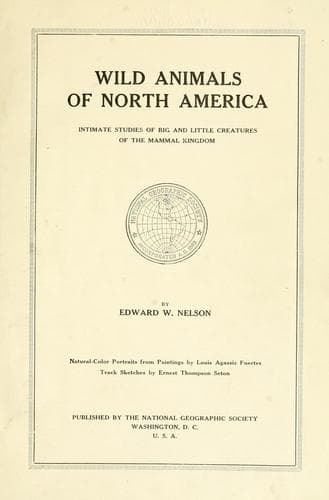
Wild Animals of North America: Intimate Studies of Big and Little Creatures of the Mammal KingdomNelson, Edward William
Science
Wild Animals of North America: Intimate Studies of Big and Little Creatures of the Mammal Kingdom
Nelson, Edward William
Mammals -- North America
Unlike many rodents, the woodchucks do not lay up stores of food
for winter. As summer draws to an end they feed heavily and become
excessively fat. On the approach of cold weather they become more
and more sluggish, appearing above ground with decreasing frequency
until from the end of September to the first of November, according to
locality, they retire to their burrows and begin the long hibernating
sleep which continues until the approach of spring.
[Illustration: MOUNTAIN-BEAVER
_Aplodontia rufa phaea_]
[Illustration: COMMON WOODCHUCK, or AMERICAN MARMOT
_Marmota monax_]
[Illustration: HOARY MARMOT, or WHISTLER
_Marmota caligata_]
Some time between February and April, according to latitude, they
come forth to resume their seasonal activities. In the northern parts
of their range they usually come out several weeks before the snow
disappears and may be tracked in it as they wander about searching for
food or a new location.
The prominence of the groundhog as a popular figure in the country lore
of the Eastern States is shown by his having been given a place with
the Saints on the calendar, February 2 being widely known as “Groundhog
Day.” It is claimed that on this date the groundhog wakes from his
long winter sleep and appears at the mouth of his burrow to look about
and survey the weather. If the sun shines so that he can see his
shadow, bad weather is indicated and he retires to resume his sleep for
another six weeks. Otherwise, the winter is broken and mild weather is
predicted. Even on the outskirts of Washington some of the countrymen
still appraise the character of the coming spring by the weather on
“Groundhog Day.”
=THE HOARY MARMOT, OR WHISTLER= (=Marmota caligata= and its
relatives)
(_For illustration, see page 535_)
The whistler is the largest and handsomest of the American marmots. It
is similar in proportions to the common woodchuck, but averages nearly
twice its weight. Its fur, far thicker and of a better quality, might
have a value in the fur trade if enough of the skins were available. As
it is, the skins are used only for robes and sometimes for clothing by
the Indians.
The distribution of this characteristic animal of the northern Rocky
Mountains and outlying ranges extends from the Endicott Mountains,
fronting the Arctic coast of Alaska, and the peninsula of Alaska,
southeasterly to the Bitterroot Mountains of Idaho, Mount Rainier,
the Olympics of Washington, and Vancouver Island. In the North its
range extends from above timber-line down over hare slopes and through
glacial valleys to the sea-level along the southern coast of Alaska. To
the southward it is limited wholly to the higher elevations, usually
above timber-line.
Owing to variations in climatic conditions and to isolation in
different parts of its range, several geographic races of the whistler
have been developed. In the mountains to the southward of its range
other marmots occur as far as New Mexico and California.
Public-domain text, read in full here on John Shaqi.
Reviews
Reviews
No reviews yet
Be the first to share your thoughts on this work.
Elsewhere in the archive
Join the Discussion
Join the discussion
Sign in to leave a comment or review.
Sign InorCreate an account