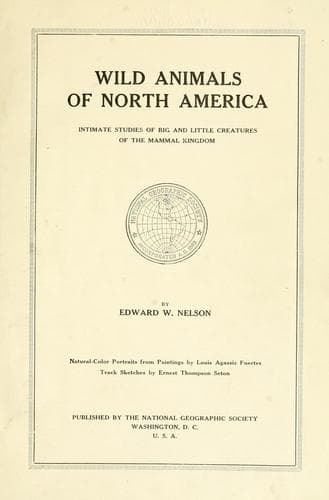
Wild Animals of North America: Intimate Studies of Big and Little Creatures of the Mammal KingdomNelson, Edward William
Science
Wild Animals of North America: Intimate Studies of Big and Little Creatures of the Mammal Kingdom
Nelson, Edward William
Mammals -- North America
When the French-Canadian voyageurs on their fur-trading expeditions
first visited the Rocky Mountains they encountered the hoary marmots
and applied to them the name “siffleur,” or whistler, which they had
already given the common woodchuck of eastern Canada. The shrill note
of the hoary marmot, under favorable circumstances, may be heard more
than a mile and justifies the restriction of the name whistler to it.
The whistler lives in such remote and unfrequented districts that
little is known of its life history. It is diurnal in habits and loves
the free open spaces of the high mountain ridges. There its loud,
oft-repeated call note, striking colors, together with its habit of
running about on the snowbanks, render it unusually conspicuous.
High in the mountains it usually inhabits rock slides, the tumbled rock
masses of glacial moraines, or rocky points, but sometimes takes up its
abode on open earth slopes or in the bottoms of little glacial valleys.
Ordinarily the dens are hidden in the rock slides and broken-down
ledges, or burrows are dug under the shelter of large boulders and even
in open ground away from any rocky shelter.
During the sunny days of summer the whistler regularly frequents the
top of some conspicuous boulder or projecting rocky point, from which
it commands a sweeping view of all its surroundings. Its sight and
hearing are extraordinarily keen, and when perched on its lookout it is
difficult to stalk. When one has its burrow located in an open place it
often sits upright on its haunches to look watchfully about, and at the
first alarm disappears into its den. This watchfulness is necessary,
for even in the remote alpine highlands it occupies, the whistler is
beset by enemies. The most formidable of these are the great brown and
grizzly bears of the North, which dig it from its burrow. In addition
prowling wolves, Canada lynxes, wolverines, and eagles take occasional
toll from its numbers.
Toward the end of summer, when the high alpine slopes are thickly grown
with small flowering herbage, the whistler feeds heavily on many of the
plants and, like the woodchuck at this season, becomes excessively fat.
Before the arrival of winter it retires to the shelter of its den and
begins the long hibernating sleep which may last six months or more. In
spring, before the snowy mantle is gone from the mountains, it is out,
ready to welcome the approaching summer. A few weeks later the three or
four young are born. They remain with the mother throughout the season
and during their first winter may hibernate in the home den.
The unspoiled wilderness of remote northern mountain slopes and ridges
where the whistler lives is also the home of the mountain sheep,
caribou, and huge northern bears. As the hardy sportsmen roam these
inspiring heights in search of game their attention is constantly
attracted to the marmots, whose presence and shrill call notes lend a
pleasing touch of life to many an otherwise harsh and forbidding scene.
Public-domain text, read in full here on John Shaqi.
Reviews
Reviews
No reviews yet
Be the first to share your thoughts on this work.
Elsewhere in the archive
Join the Discussion
Join the discussion
Sign in to leave a comment or review.
Sign InorCreate an account