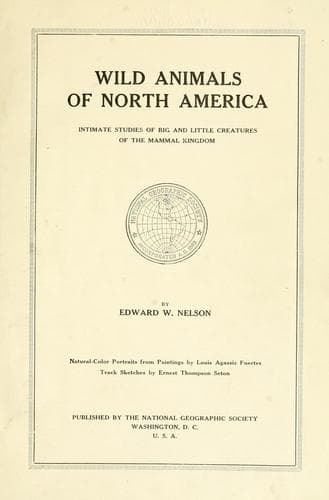
Wild Animals of North America: Intimate Studies of Big and Little Creatures of the Mammal KingdomNelson, Edward William
Science
Wild Animals of North America: Intimate Studies of Big and Little Creatures of the Mammal Kingdom
Nelson, Edward William
Mammals -- North America
=THE PRAIRIE-DOG= (=Cynomys ludovicianus= and its relatives)
(_For illustration, see page 538_)
Prairie-dogs are not “dogs,” but typical rodents, first cousins to the
ground squirrels, or spermophiles. As a rule, they may be distinguished
from the ground squirrels by their larger size, proportionately
shorter and heavier bodies, and shorter tails. In length they vary from
fourteen to over seventeen inches, and in weight from one and one-half
to more than three pounds.
These rodents are limited to the interior of North America and form
a small group of five species and several geographic races. Although
closely alike in general form and habits, the species are divided into
two sets: one, the most widely distributed and best known, having the
tails tipped with black, and the other having the tails tipped with
white.
On the treeless western plains and valleys from North Dakota and
Montana to Texas and thence west across the Rocky Mountains to Utah
and Arizona, they are one of the most numerous and characteristic
animals. Southward they range into northwestern Chihuahua and one
species occupies an isolated area on the Mexican table-land in southern
Coahuila and northern San Luis Potosi, Mexico. Their vertical range
varies from about 2,000 feet on the plains to above 10,000 feet in the
mountainous parts of Colorado and Arizona.
Owing to their diurnal habits, their exceeding abundance over vast
areas, and their interesting mode of living in colonies, prairie-dogs
have always attracted the attention of travelers and have become one
of the most widely known of our smaller mammals. All who have lived
in the West, or who have merely traversed the Great Plains on the
transcontinental railroads, have had their interest excited by these
plump little animals sitting bolt upright by the mounds which mark the
entrances to their burrows, or scampering panicstricken for shelter as
the train roars through their “towns.”
So strong is the gregarious instinct in prairie-dogs that they
customarily make their burrows within short distances of each other,
varying from a few yards to a few rods apart. The inhabitants of these
communities, or “towns,” as they have often been termed, vary in number
from a few individuals to millions. In western Texas one continuous
colony is about 250 miles long and 100 miles wide. In the entire State
of Texas 90,000 square miles are occupied by prairie-dogs, and the
number of these animals within this area runs into the hundreds of
millions. The extent to which they occupy parts of their territory is
well illustrated by one situation in a mountain valley, containing
about a square mile, in eastern Arizona, which by actual count
contained 7,200 of their burrows.
Public-domain text, read in full here on John Shaqi.
Reviews
Reviews
No reviews yet
Be the first to share your thoughts on this work.
Elsewhere in the archive
Join the Discussion
Join the discussion
Sign in to leave a comment or review.
Sign InorCreate an account