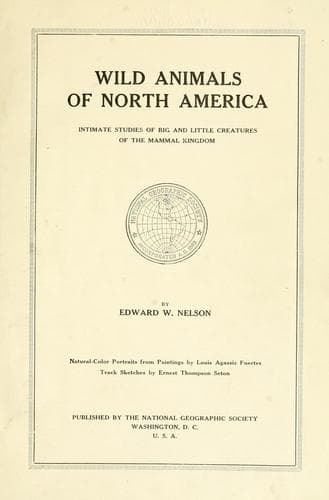
Wild Animals of North America: Intimate Studies of Big and Little Creatures of the Mammal KingdomNelson, Edward William
Science
Wild Animals of North America: Intimate Studies of Big and Little Creatures of the Mammal Kingdom
Nelson, Edward William
Mammals -- North America
The burrows, from four to five inches in diameter, are usually located
on flat or gently sloping ground. They descend abruptly from eight to
sixteen feet, then turn at a sharp angle and extend ten to twenty-five
feet in a horizontal or slightly upward course. The tunnel at the end
of the steep descending shaft is always more or less irregular in
course, and branches in various directions, the branches often ending,
in a rounded nest or storage chamber, but sometimes forming a loop back
to the main passageway. Not infrequently two entrances some distance
apart lead to these deep workings. A little niche is ingeniously dug
on one side of the steep entrance shaft, four to six feet below the
surface, to which on the approach of danger the owner retires to listen
and determine whether it may or may not be necessary to seek safety
in the depth of the den. It is from these vantage points that the
resentful voices of the habitants come to an intruder in a prairie-dog
“town” as he passes.
The black-tailed prairie-dog, which is so numerous on the Great Plains,
surrounds the entrance to its burrow with a crater-shaped pyramid
of soil varying from a few inches to nearly two feet in height and
serving perfectly as a dike to keep out the water. The owners keep the
funnel-shaped inner slopes of the rims about the entrances in good
condition by setting briskly to work to reshape them at the end of a
rain-storm, digging and pushing the earth in place with their feet and
molding it into a more compact mass by pressing it in with their blunt
noses.
The white-tailed prairie-dogs pile the dirt from their excavations out
on one side of the entrance, as in the case of most other burrowing
animals. Sometimes the dirt in these piles amounts to from ten to
twenty bushels, thus indicating extended underground workings.
The vivacity and hearty enjoyment of life by the occupants of a
prairie-dog “town” is most entertaining to an observer. With the first
peep of the sun above the horizon they are out on the mounds at the
entrances of their burrows, first sitting erect on their hind feet
and looking sharply about for any prowling enemy. If all is well they
begin to run about from one hole to another, as though to pass the
compliments of the day, and scatter through the adjacent grassy feeding
ground.
Public-domain text, read in full here on John Shaqi.
Reviews
Reviews
No reviews yet
Be the first to share your thoughts on this work.
Elsewhere in the archive
Join the Discussion
Join the discussion
Sign in to leave a comment or review.
Sign InorCreate an account