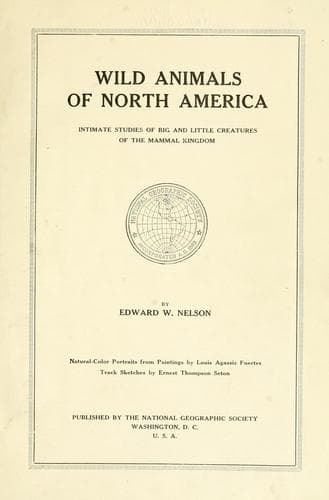
Wild Animals of North America: Intimate Studies of Big and Little Creatures of the Mammal KingdomNelson, Edward William
Science
Wild Animals of North America: Intimate Studies of Big and Little Creatures of the Mammal Kingdom
Nelson, Edward William
Mammals -- North America
The golden chipmunk, or calico squirrel, as it is named in Oregon, is
the most richly colored of the several geographic races of a widely
known species, _Callospermophilus lateralis_, abundant among the open
forests of yellow pines and firs of the western ranges, including
the Rocky Mountains, Cascades, and Sierra Nevada. Although commonly
known as a chipmunk, this handsome animal is a ground squirrel,
or spermophile, distinguished from all its kind by heavy stripes,
resembling those of a chipmunk, along the sides of its back. From the
chipmunks it may be distinguished at a glance by its thick-set and
often almost obese proportions, which render its movements much slower
and less graceful than they are with those nimble sprites. It occurs
from northeastern British Columbia to New Mexico, southern California,
and even in an area in the high Sierra Madre of southern Chihuahua,
where an isolated representative occupies a limited range.
[Illustration: GRAY SQUIRREL (and black phase)
_Sciurus carolinensis_]
[Illustration: RUSTY FOX SQUIRREL
_Sciurus niger rufiventer_
FOX SQUIRREL
_Sciurus niger_]
Their vertical distribution extends from a moderate elevation above the
sea in Oregon to above 11,000 feet in southern California. They are
common in the Yellowstone and other national parks, where their size,
bright markings, and activities render them conspicuous.
Everywhere their habits resemble those of the various species of true
chipmunks with which they associate. They live in burrows, which they
dig under the shelter of logs, rocks, stumps, roots of trees, or even
in open ground, as well as in the ready-made shelter of rock slides,
with conies, at timberline. Their burrows at times have several
entrances within a small area. Often they occupy the burrows of other
animals, including pocket gophers. They excavate burrows under cabins
or barns in clearings, and abandoned mining camps or old sawmill sites
frequently abound with them. Nests and storage chambers are excavated
off the passageways. The nests are usually made of leaves and other
soft vegetable material, but in the sheep country wool, which they find
in scattered tufts, is often used.
A camping party in their haunts is certain to attract them, and, as
about barns, it is necessary to keep a watchful eye on them to prevent
their robbing grain sacks or other supplies. When they once locate an
accessible supply of grain their industry is remarkable. I have seen
a dozen or more working throughout the day, making continuous hurried
trips, with loaded cheek pouches, to their dens, sometimes two hundred
yards away. On approach of autumn they become continually active,
gathering their winter supplies.
Public-domain text, read in full here on John Shaqi.
Reviews
Reviews
No reviews yet
Be the first to share your thoughts on this work.
Elsewhere in the archive
Join the Discussion
Join the discussion
Sign in to leave a comment or review.
Sign InorCreate an account