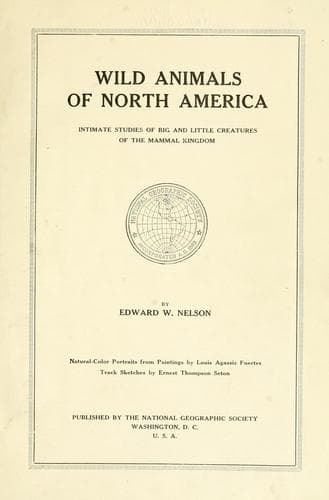
Wild Animals of North America: Intimate Studies of Big and Little Creatures of the Mammal KingdomNelson, Edward William
Science
Wild Animals of North America: Intimate Studies of Big and Little Creatures of the Mammal Kingdom
Nelson, Edward William
Mammals -- North America
The length of their hibernation varies with the severity of the
climate, but is rarely under five months. It is said to run through
seven months on the higher mountains of southern California. They
usually go into winter quarters in September or early in October, but
occasionally one may be seen out as late as December. At this time they
have become so fat that their movements are very sluggish. One kept as
a pet for eleven years at Klamath Falls, Oregon, is reported to have
hibernated regularly each winter. In Montana they retire to their dens
in September and come out in March. They mate soon after they appear in
spring and the young, four to seven in number, are half grown the last
of May.
Like true chipmunks, these spermophiles are fond of weedy clearings or
other openings in the forest, where stumps, logs, rocks, and old fences
offer plentiful shelter and many elevated vantage points where they may
sit by the hour watching the doings of their small world. They have a
sharp whistling or chirping call note, usually uttered as a warning
cry, but sometimes as a social call. They do not like gloomy or stormy
weather and generally lie hidden at such times, but on sunny days are
so actively engaged in foraging, running along the tops of logs, or
perching on the tops of stumps and large rocks that they add greatly
to the pleasant animation of the forests where they live. When running
they usually carry the tail elevated like a chipmunk.
They sun themselves for hours on elevated points, sometimes lying
quiescent and again sitting bolt upright, but always watchful and ready
to disappear at the slightest alarm. This watchfulness is necessary,
for their enemies are abroad at all hours. They are the prey of
bobcats, foxes, coyotes, weasels, snakes, and hawks.
The golden chipmunk and its related subspecies are omnivorous feeders.
They show a strong predilection for bacon when looting camp stores and
eat any kind of meat with avidity. Young birds and birds’ eggs are
devoured whenever found, as are also grasshoppers, beetles, flies,
larvæ, and many other insects. The number of kinds of seeds eaten is
almost endless and includes chinquapin and pine nuts, rhus, alfileria,
violet, lupine, ceanothus, and others. They also eat roses and other
flowers, green leaves, wild currants, gooseberries and other fruit, and
small tuberous roots. They often climb bushes and low trees, at least
30 feet from the ground, after nuts and berries. The capacity of their
cheek pouches is shown by one instance, when one animal was loaded with
750 serviceberry seeds. The pouches of another contained 360 grains of
barley, another 357 of oats. Bold and persistent camp robbers, their
depredations cover all articles of food, including bread and cake, and
they sometimes do considerable injury to small mountain grain fields.
Public-domain text, read in full here on John Shaqi.
Reviews
Reviews
No reviews yet
Be the first to share your thoughts on this work.
Elsewhere in the archive
Join the Discussion
Join the discussion
Sign in to leave a comment or review.
Sign InorCreate an account