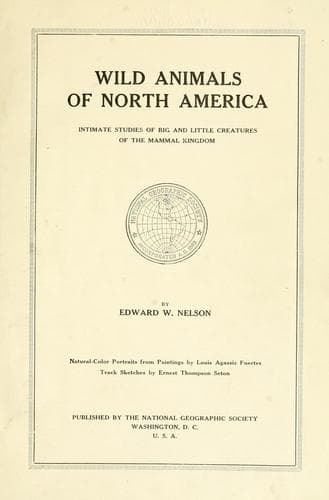
Wild Animals of North America: Intimate Studies of Big and Little Creatures of the Mammal KingdomNelson, Edward William
Science
Wild Animals of North America: Intimate Studies of Big and Little Creatures of the Mammal Kingdom
Nelson, Edward William
Mammals -- North America
I had the pleasure of living in the mountains of New Mexico and
Arizona for several years where these attractive ground squirrels were
numerous, and vividly remember them as among the most interesting of
the woodland folk. Their friendliness about forest cabins is notable
and with a little encouragement they become extremely confiding and
amusing visitors.
The young are playful, pursuing one another in apparent games of “tag”
over rocks, stumps, and logs. When partly grown they have all the
heedlessness of youth and on one occasion an observer saw the mother
repeatedly push the young back into crevices in a rock slide with her
front feet, as they persisted in trying to come out to look at the
strange intruder in their haunts.
=THE EASTERN CHIPMUNK= (=Tamias striatus= and its relatives)
(_For illustration, see page 542_)
The chipmunks are close relatives of the tree squirrels, but live
mainly on the ground, are provided with cheek pouches for carrying
food to their hidden stores, and have many ways similar to those of
the spermophiles, or ground squirrels. They are nearly circumpolar
in distribution, ranging through eastern Europe and northern Asia as
well as from the Atlantic to the Pacific in North America. On this
continent they are far more numerous in species and individuals than
in the Old World, and their center of abundance appears to lie in the
mountainous western half of the United States. Their extreme range
extends from near the Arctic Circle in Canada to Durango and Middle
Lower California, Mexico.
As a group the chipmunks are widely known for their grace, beauty of
coloration, and sprightly ways. Among the handsomest and most familiar
is the common chipmunk of Canada and the United States east of the
Great Plains. Within this area it is divided into several geographic
races, of which the best known is the brightly colored animal occupying
all the wooded region from the Great Lakes to Nova Scotia and New
England, which is the subject of the accompanying illustration. Its
vertical distribution extends from sea level to the summit of Mount
Washington, where it may be seen on pleasant summer days.
The eastern chipmunks, like most of their kind, belong to the forest
and its immediate environment. Favorite haunts are rocky ledges covered
with vines and brush, half-cleared land, the brushy borders of old
pasture fences, stone walls, and similar situations. In early days
they were so plentiful in places that they made serious inroads on
the scanty crops of the settlers, and bounties were offered for their
destruction.
Public-domain text, read in full here on John Shaqi.
Reviews
Reviews
No reviews yet
Be the first to share your thoughts on this work.
Elsewhere in the archive
Join the Discussion
Join the discussion
Sign in to leave a comment or review.
Sign InorCreate an account