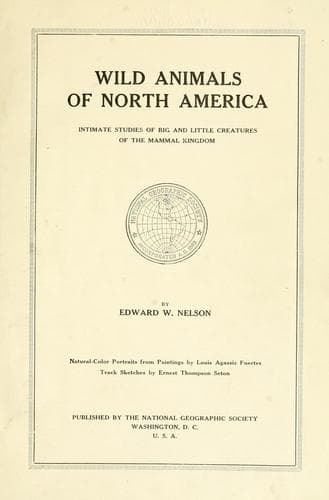
Wild Animals of North America: Intimate Studies of Big and Little Creatures of the Mammal KingdomNelson, Edward William
Science
Wild Animals of North America: Intimate Studies of Big and Little Creatures of the Mammal Kingdom
Nelson, Edward William
Mammals -- North America
No one who visits the woods of the eastern States or Canada can fail
to observe with pleasure the alert, attractive ways of these little
squirrel-like animals. They are everywhere, including the vicinity of
summer camps in the forest, and, if encouraged, prove most attractive
and friendly neighbors. To such small beasts the world is peopled with
enemies against which the only safeguard is eternal watchfulness. This
accounts for the hesitating advances and retreats so characteristic of
these chipmunks, which at the first sudden movement of any suspicious
object, or loud noise, disappear like a flash. They soon learn to
recognize a friend and in many places come regularly into camp
buildings to receive food. I doubt, however, if they ever become quite
so friendly as some squirrels under similar conditions.
Like most of the squirrel tribe, they are endowed with much curiosity,
and at the appearance of anything unusual, but not too alarming, they
seek some safe vantage point from which to peer at it with every sign
of interest. They are extremely timid and wary, however, and if
doubtful move by little cautious runs, stopping to sit up and look
about, often mounting a stump, log, or a side of a tree trunk for the
purpose, the tail all the time moving with slow undulations. If alarmed
they dash away to the nearest shelter, the tail held nearly or quite
erect and sometimes quivering excitedly. When running to shelter they
often utter chattering cries of alarm. Their principal enemies are
cats, weasels, martens, foxes, snakes, birds of prey, and the untamed
small boy with his dog. Weasels, the supreme terror of their existence,
follow them to the depths of their burrows and kill them ruthlessly.
These chipmunks are sociable and playful, often pursuing one another,
first one and then the other being the pursuer, as though in a game.
They race along fence tops and old logs and up stumps and even the
lower parts of tree trunks. Lovers of bright, sunny weather, they
usually remain hidden in their burrows during stormy days. If they
venture out at such times they are quiet and show none of the mercurial
liveliness which characterizes them when the weather is pleasant.
Their food includes a great variety of cultivated and wild plants, as
wheat, buckwheat, corn, grass seed, ragweed seed, hazelnuts, acorns,
beechnuts, strawberries, blueberries, wintergreen berries, mushrooms,
and many others. In addition they eat May beetles and other insects and
insect larvæ, snails, occasional frogs, salamanders, small snakes, and
many young birds and eggs.
Public-domain text, read in full here on John Shaqi.
Reviews
Reviews
No reviews yet
Be the first to share your thoughts on this work.
Elsewhere in the archive
Join the Discussion
Join the discussion
Sign in to leave a comment or review.
Sign InorCreate an account