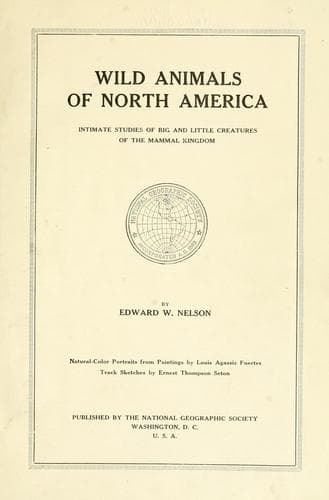
Wild Animals of North America: Intimate Studies of Big and Little Creatures of the Mammal KingdomNelson, Edward William
Science
Wild Animals of North America: Intimate Studies of Big and Little Creatures of the Mammal Kingdom
Nelson, Edward William
Mammals -- North America
Mink dens are located wherever a safe and convenient shelter is
available, and may be a hole in a bank, made by a muskrat or other
animal, a cavity under the roots of a tree, a hollow log, a hollow
stump, or other place. The nest is made of grass and leaves lined with
feathers, hair, and other soft material. A single litter of from four
to twelve small and naked young is born during April or May.
The young remain with the mother throughout the summer, and do not
leave her to establish themselves until fall, when they are nearly
grown. When captured at an early age they are playful and become
attached to the person who cares for them. When caught in a trap they
become fiercely aggressive, often uttering squalling shrieks, baring
their teeth, and fronting their captor with a truculent air of savage
rage. The adults have scent sacs located under the tail like those
of a skunk. When angry or much excited they can emit from these an
exceedingly acrid and offensive odor, but have no power to eject it
forcibly at an enemy.
Minks are bold and courageous in their attitude toward other animals,
and attack and kill for food species heavier than themselves, like
the varying hare and the muskrat. On land they are persistent
hunters, trailing their prey skillfully by scent. They eat mice,
rats, chipmunks, squirrels, and birds and birds’ eggs of many kinds,
including waterfowl, oven-birds, and other ground-frequenting species.
About the waterside they vary this diet by capturing fish of many
kinds, which they pursue in the water, snakes, frogs, salamanders,
insects, crustaceans, and mussels.
Their prowess is shown by their raids on chicken-houses, where they
often kill many grown fowls in a night, and sometimes drag birds
heavier than themselves long distances to their dens. A remarkable
indication of the varied menu of the mink was exhibited in a nest found
by Dr. C. H. Merriam, where the owner had gathered the bodies of a
muskrat, a red squirrel, and a downy woodpecker.
The value of the mink’s furry coat has led to its steady pursuit by
trappers in all climes, from the coast of Florida to the borders of
sluggish streams on Arctic tundras. Millions of them have fallen
victims to this warfare and their skins have gone to adorn mankind. In
spite of this the mink today occupies all its original territory, and
each year yields a fresh harvest of furs.
Public-domain text, read in full here on John Shaqi.
Reviews
Reviews
No reviews yet
Be the first to share your thoughts on this work.
Elsewhere in the archive
Join the Discussion
Join the discussion
Sign in to leave a comment or review.
Sign InorCreate an account